Illulissat on the Rocks

We land in Kangerlussuaq, Greenland because that is the location of the international airport. It used to be a US military installation, and therefore has the only runway in the country large enough for a 747. Other than the airport, the town consists of a dozen old buildings with corrugated siding that house a school or hotel or whatever. But our connection isn’t for a couple hours, so we get in a bus for the ‘nature and tundra’ tour, which consists of driving over a murky river and up a hill where we see a reindeer and caribou and a rabbit. It is not an auspicious start.

But a couple hours later we are flying over some cool landscape before landing in Illulissat, which means ‘iceberg’ in Greenlandian – and it is beautiful and strange and all the things you hope Greenland will be. Quick Geography -Greenland is 20 times larger than Iceland. It is one fifth the size of the US. But 80 percent of it is a big ice cap and unless you are a tough as nails Inuit, uninhabitable. The towns are all on the fringe, and you could fit the entire population into Dodger stadium. Illulissat is its 3rd largest town with 4500 people.

The Hotel Arctic is surprisingly modern and comfortable. The day we arrive the weather is typical for July, upper 50s and sunny. It will stay sunny until close to midnight when the sun sets. And then rises about 20 minutes later.

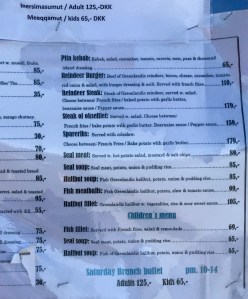
There aren’t many places in town to eat, and we end up taking all of our meals at the hotel. The buffet always has a variety of fish and some kind of meat. Sometimes reindeer or musk ox. There is seal soup and dried whale. But also egg strata and fried rice and pasta. If all else fails, there is a dark, hearty local bread which is good with cheese.

The dining room is huge, and glass, with views of the icebergs floating in the bay, and the sled dogs who live outside all the time and are not to be pet.

Our first tour is in a small plane, 5 seats and a pilot, that flies us over the ice shelf and the bergs.
F5527A8D-10AB-4A48-ADF5-92D1668FFCACOur pilot is a pretty, young Danish girl. All of our guides will turn out to be good looking young Danish people who work the tourism here during the brief summer.
028C61ED-60CE-41FA-97DC-C8125C086467.

We see a couple whales. It’s all very serene and bright and wondrous – the ice shelf ruffled in places like frosting on a wedding cake.

That evening we take the late Disko Cruise.’ Disko is a small island off the coast, and the boat seats about 8 of us. We set out around 10 pm and it is quite cold on the water which is good because we are groggy with sleep. But the vistas, as we weave between the icebergs, are spectacular.

The ice changing color in the fading light, from soft pink to lavender. At one point we pull up to a small berg and our guide (pretty, young, Danish) chips off some ice cubes and makes us a little cocktail.

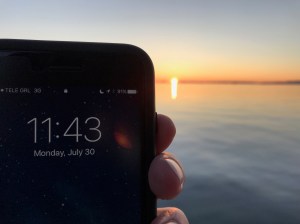
In a quiet cove we watch a whale dive with a swish of its fluke. At 11:45pm the sun sets and we head back, a fulmar bird bobs along beside us.

But it never gets fully dark before the sun rises again by the time we are back in our room.
F5EC4BEE-1E5F-4D83-BA3B-A37B2206BE2E

There are blackout curtains and you have to use them. 

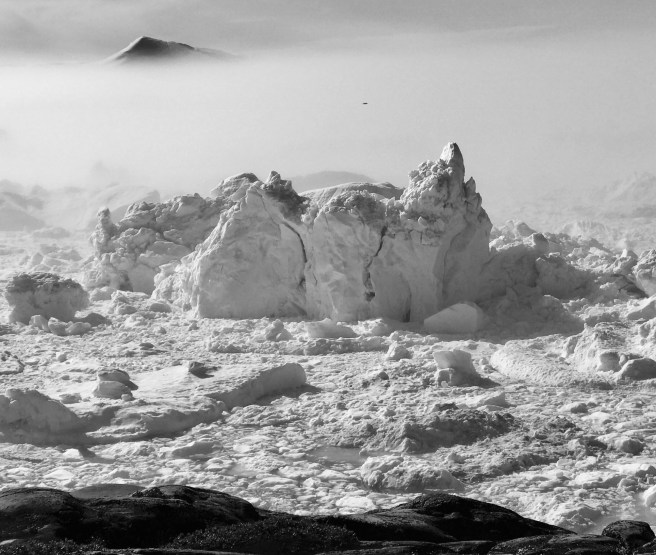
The next morning is socked in with fog. Still we hope for the best as we head out for a hike over a winding boardwalk through Sermermuit, a UNESCO site. The path meanders along beside some old Inuit ruins, which are basically mounds that are nearly indistinguishable from the rest of the landscape. There are some pretty wildflowers and a quiet little bay. At the end of the boardwalk we take a path between some large boulders and come upon the iceberg trough, which is blanketed in thick fog. But we wait around a bit and eventually the fog lifts offering a breathtaking view.

We are told that in the past, the old maids and widows of the Inuits came here to throw themselves into the sea- much like stories of old Eskimos being put out to sea on an ice flow to die.
EF36D341-18FF-42F4-9B0E-025F38D9ECD2

In the afternoon we tour the town of Illulissat; we see the church and firehouse and school and small museum. The buildings are all different colors, which originally was a way to identify what service they provided, but now is just random. There are no traffic signs or lights, and cars speed recklessly through the narrow streets. There is a butchery where the local people line up to purchase hunks of freshly slaughtered Minky whale.
E09F0095-2FDD-4F7C-ACC2-4C53D51252EE  We visit the home of a local woman, whose name sounds like Trina, who still lives a more or less traditional life. She and her husband keep several working dogs, all on long chains in the yard who greet us upon arrival.

The dogs always stay outside and in the wintertime pull their sled when they go hunting and camping on the ice. The house she lives in is modern, but during the long, dark winters, when they dogsled out on weekends, she wears seal pelts and ‘dogskin pants’ for warmth. She is Inuit like most of the local population, with ruddy skin and black hair. She has an elaborate beaded costume with white sealskin boots she wears on special occasions,  that she also works as a ‘reflexologist,’ and she serves us coffee and cheesecake while we chat.
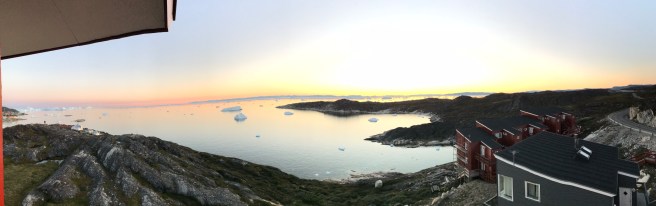
A6A7C6DC-524E-4678-A141-6D9AC8CE4E2CI wonder how tourism will change these people. This is the last night of our trip, and this is the most remote and wild place we have visited. But it seems it’s only a matter of time before it becomes a ‘destination.’ The young people drink Coca-Cola and prefer snowmobiles to dog sleds. I think of Trina, and her dog pants. My own dog passed away just before this trip, and I keep his ashes in a box. I miss him terribly. 

He would’ve made a beautiful pair of pants. 
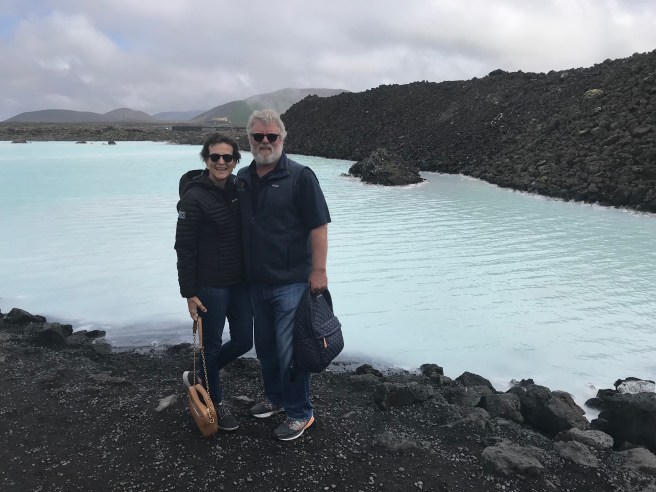
Iceland; like Portland but with glaciers and puffins

Reykjavik is a hip little bustling town. Very Brooklyn/Portland/Austin. Walkable streets, funky galleries, cool graffiti, man-buns, coffeehouses with punny names, youngsters who party until the bars close. which is at 4:30am. At which point they stumble home roaring drunk, howling and puking beneath our hotel window, which is open. Because Iceland has no AC and contrary to its name, not all that icy. 

Our first stop is the Blue Lagoon spa. Here we lunch and then change into our suits for a soak in the warm, milky waters. We swim up to bars where we get beer and wine and cheap sunglasses as the brightness is numbing, another where we get a handful of white glop to spread over our faces – when we rinse it off 20 minutes later we get a handful of green glop. The silica in the water gets in my hair and it takes days to wash it out completely, but apparently it is all healthy and whatnot – 

A1110CC0-7B20-4C0A-A709-5D4F9D00DCC4

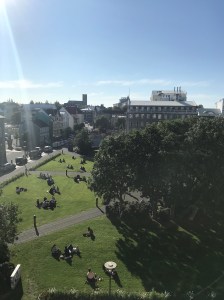
It’s another hour to the hotel where we unpack and enjoy the view from our room overlooking the park which is packed with people as apparently the weather had been awful and this is the first day the Icelanders have seen the sun in several weeks. It looks like a university quad down there. 

0E6655BC-B9E6-4AC7-965C-84BDC69CBE94

Dinner is at Idno, housed in an old theater. The food is pretty good and well presented, with a turkey/mashed potato thing as our entree, which is the first time we’ve seen turkey on the trip, likely because we are American. Icelanders mostly eat fish – what they call trout but is larger, pink and firm like salmon and a lot of lamb. Even the hot dogs here are made from lamb.

Following dinner we are entertained by a woman’s choir singing Icelandic songs. (It is very, very white here.)

We take a short stroll around town and explore. Lots of Viking this and Viking that. At night in our room we are treated to sounds like raping and pillaging in days of yore as revelers make their way home from the bars.

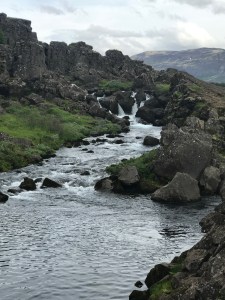
The next day we get in monster jeeps and tour the “golden circle” which includes Trollish rock formations013C9D71-C18B-4DEB-9092-49E44AC93EFF

and geyser hot springs

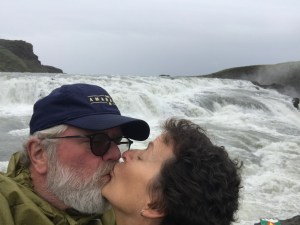
and the Gulfoss waterfall.

124A9633-1A1F-4396-9E68-0C402565D3F9.

There is a pool of water where in olden days they used to execute unfaithful women by drowning them in a bag. Like kittens!

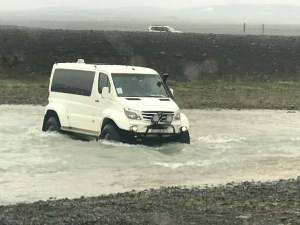
Afterwards they deflate the tires on the monster jeeps and we four-wheel through rocky creek beds on our way to Langjokull glacier.

F72BEDEE-C09A-495A-A180-EE745DEE0CE2

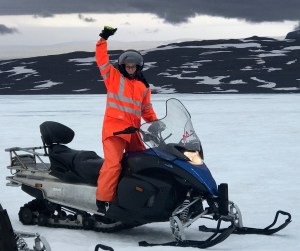
There we put on huge down jumpsuits and gigantic orange rain gear and gloves and boots and helmets and schlepp out to the glacier where snowmobiles are waiting for us. It starts to rain and the ice is incredibly slippery and we are walked out clutching our guides who have crampons. But once the snowmobile starts we race out – the rain stops and the ice turns fluffy and soft and it’s completely magical – hushed and powerful.

BC978482-32B8-4B00-9A27-842FFAE65A10

We get back to the hotel late and stumble out to Apotek for dinner – which is super hipster and serves some shellfish starter on top of a block of pink Himalayan salt followed by cubes of lamb tartar. We are too full and tired to enjoy our entrees when they arrive. It’s midnight when we tumble out, and just getting dark.

Our final day we decide to explore on our own. We find an adorable brunch spot called Snaps and get bloodys and avocado toast just like home. Then we wander the streets finding a lot of cool graffiti, and street musicians, and a stone church, and other nonsense. We shop and goof and get back just in time to go whale watching.

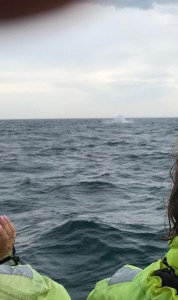
Around then the weather turns bad, but the whale watching boat goes out anyway. It is incredibly rough and despite wearing the rain gear they provide everyone gets soaked. We see some amazing breeches – animals fully in the air, but taking photos is impossible as we are all hanging on for dear life.

F3F4B6C6-AB8D-4522-B627-E0B58B351008Several people huddle below deck, watching through windows, because it’s so rough, and by the time we are told to get below for the return, as waves slosh over our heads crashing onto the deck, things have taken a bad turn below and vomit bags are everywhere. We hang out at the door, despite the deluge, just to stay out of the grim.
That night it cleared up and we took a short ferry ride to Videy Island for a private dinner in a big old barn.

ACB5206F-D194-4104-A27E-0F56B3E65372No one puked. Success!

Alesund…my aim is true

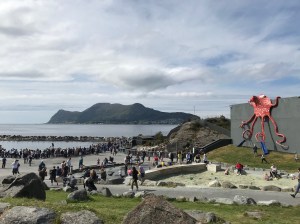
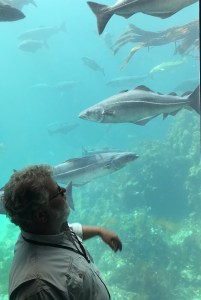
We land in Alesund Norway and travel straight to Klippfiskakademiet, a culinary institute/aquarium where we are given a brief tutorial on the barabcoa – a Norwegian white fish that can be salted and dried and basically tucked away under your bed and forgotten for several years, but revived with water and consumed. I remain unconvinced. But lunch is delicious and the aquarium oddly has some adorable penguins (shipped in from South Pole but thriving,) and other creatures.

11629DA7-AE99-4C85-ACB2-89182D22CBE2

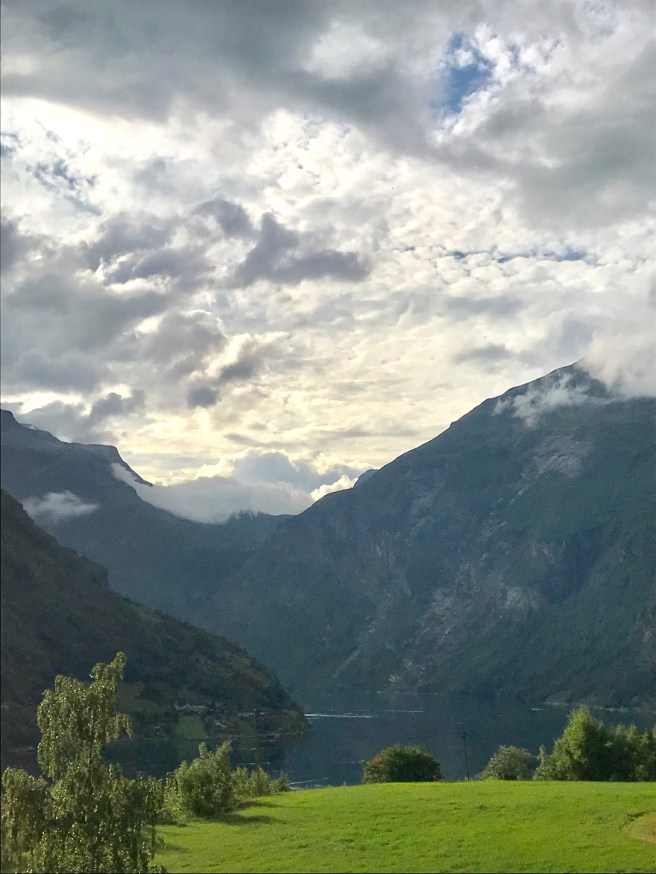
7F1BBFDA-C993-4768-B743-5DF29910E013Then it’s a 2 plus hour drive and a ferry to the hotel Union Geiranger on the fjord. Our guide explains points of interest, like where the last witch was burned, and has funny colloquialisms like “he was an easy one to make a monkey bird” which I think means make a fool of.
E43B4B94-31D6-448D-9784-6D35AC7BABC9

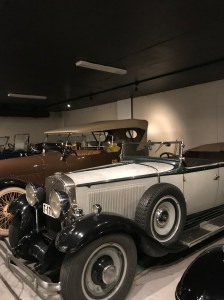
We prowl through the hotel, which has an amazing collection of old autos in the basement – cars that the hotel used to retrieve guests form the cruise ships back in the 20s. The entire property was occupied by nazis in WWII and the cars confiscated. But they were later recovered and the few that hadn’t been destroyed or cannibalized for bits and parts restored to their former glory.

A9E3E5F4-2211-4FC9-85DC-38D6E8CF07C5

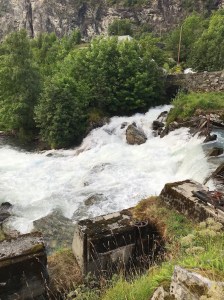
The property also has a multi tiered outdoor stairwell outside that runs alongside a stunning waterfall offering views of the fjord with its steep sheer walls formed by glacier. 

152CE1FA-86FC-43E8-8A0E-6B66C6359E41

The next day we get up early to kayak. The water is smooth and easy to navigate, even with the occasionally passing ferry, and the day warm and sunny. We pass a farm on the shore, where goats roam freely, and are told there is no danger of them jumping into the fjord as goats fear water because they are not ‘water tight’ and in fact water will drown them through their anus – which sounds improbable, but we’ve also heard a bit about trolls and witches since we’ve been in this country, so not arguing.

Later that afternoon we take a pretty walk in the local mountains and see a lot of goats and some llamas and breathtaking views. Norway is all about spectacular scenery and it seems around every bend are greener mountains or more dramatic falls or more reflective fjords.

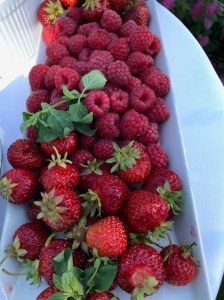
The hotel has a lovely spa and I get a foot massage while Kevin enjoys the pool. That evening we are treated to an outdoor cocktail hour with some of the best berries I’ve ever had,

23645A65-1E48-49C6-B337-FCED0E08712B

followed by some sweet/humorous folk dancing performance by local octogenarians 

and then a dinner served in a traditional dirt/weed roofed cottage. We’ve seen these traditional cottages all over the landscape and apparently it was an early form of insulation – or something else.

Not sure what you can believe in Norway.

Bloody Bloody St. Petersburg


St Petersburg was the capital of Russia for a while back in the days of the emperors, but when that all went to hell in a revolutionary hand-basket it was renamed Leningrad and poorly neglected. And then it was occupied by Nazis.

Over the last 25 years or so since perestroika, they’ve spiffed it up, restoring all the grand palaces and homes of the wealthy and elite (who long ago were slaughtered or sent to Siberia) and it is a beautiful, bustling very European city once more.

3C50A8FE-F79E-4D33-BDDF-2D3DE052280A

Much like the stories of the kings and queens of England, the stories of the Tsars dating all the way back to Peter the Great are steeped in blood. Fathers killing sons, sons killing fathers, wives killing husbands, husbands banishing wives, peasants rising up and slaughtering the lot of them, it’s pretty grim (and entertaining) stuff. 

Like Venice, it is a city of rivers and canals and pretty bridges and embankments lined with buildings in colorful pastels. There are large public squares and archways and cathedrals. Statues of men, most of whom were murdered in some grisly fashion or another.

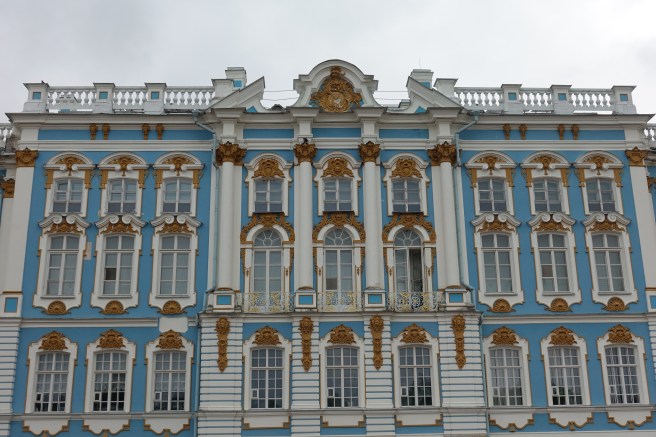
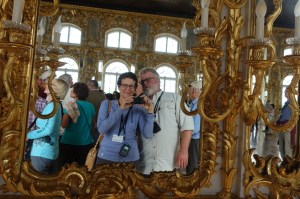
Our first day we spent touring Catherine’s palace, named for both Catherine the first,

FE5B5475-8083-4961-98E8-42621E4D798C.jpeg Peter the Great’s pretty German wife (whom he took after forcing his first wife into a monastery) and Catherine the Great, another German wife of a later emperor, who had her spouse killed and ruled happily alone for two decades and took several lovers. 
13BF4B29-DDEE-439A-8C10-44C0D40B76F5

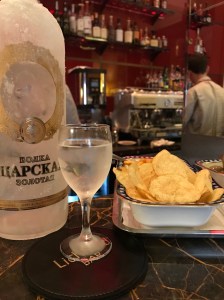
That evening we dine at the Russian Vodka Room on caviar and vodka and Pate and dumplings and something called Salo which is thin rolls of salted lard on rye bread with spicy mustard and a scrape of garlic. We sit out on the terrace where it stays warm and light well past 10pm. We are promised a floor show with gypsies and a dancing bear, but leave before said bear arrives.

424E8006-EDB7-4E4A-B1C7-11E1EA39F959

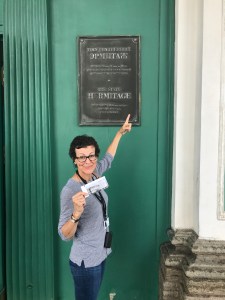
The next day we head to the Hermitage, founded in the mid 1700s by Catherine the Great and the second largest museum in the world. Beyond the extensive collection of art by such masters as Rembrandt and DiVinci, the buildings themselves are set up as a lavish multi room palace. We are lucky to be there on a Monday, when the museum (which generally gets over 20,000 visitors a day in summertime) is closed to the public. Not only is the place empty,

but we get a private view of the winding of the peacock clock – an amazing golden machine


– and we get to watch local art students who come in on Mondays to copy masterpieces as part of their schooling (always scaled larger or smaller than actual – to avoid possible counterfeiting) 

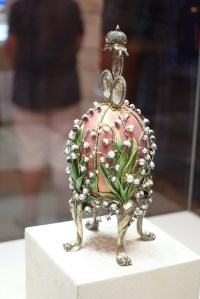
We lunch at restaurant Mansarda atop the gas building overlooking the St. Isaac’s Cathedral. Then head to the Faberge museum to see the infamous eggs, which were created as gifts from one of the slaughtered tzars for his slaughtered wife.

3919CFBA-8B59-406F-8D55-E066CAFCF61B

And then The Church of the Savior on spilled blood – which gets its name from (surprise!) the actual pavement upon which one of the other emperors was slaughtered. It is pretty astounding, full of amazing mosaics and packed with tourists.

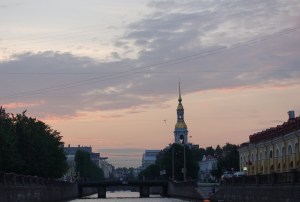
That evening we take a river boat cruise on the Neva and its canals. The architecture of the buildings that line the river is gorgeous, huge rococo buildings in pastel mint and apricot and buttercup yellow – passing under several pretty bridges. 

Our final full day in St Petersburg we take a hydrofoil across the river to Peterhof, the summer home or ‘dacha’ of Peter the Great built after he visited Versaille – from where he borrowed the ideas of formal gardens and several fountains, one of which goes off every house on the hour like it’s the Bellagio in Vegas and attracts throngs.

During WWII St Petersburg was occupied by Nazi troops, and here as well as in several other places we visit, years of painstaking restoration has been required to return the monuments to their pre war splendor. 

After Peterhof, we take an afternoon to just wander the city and shop for gifts. The streets are very ‘grid like’ and it’s easy to navigate. Walking along the canal on the way home some petty crooks are nearly successful in picking my pocket (or purse in this instance) but I struggle to find my own keys in that thing, and they were defeated by its mess. 

That evening we head to Yussupov Palace. Like all the other glorious palaces it was once owned by a noble family and was the location of a fabulous murder. (Or as said with proper Russian accent, more-deer) This was the place the last Tsar’s right hand guy, Rasputin, was killed. First poisoned with a cookie, the stabbed, then hog-tied and thrown in the river to make sure he was really, most sincerely, dead. 

Inside the palace, we are taken through several large, fancy chandeliered rooms to a jewel box of a theater where we watch a sweet ballet performance.

Then in the ballroom we dine and listen to opera.

Then back to the hotel for our final night of ‘one and done’ beluga vodka in the bar.

456ACB1A-1D82-4FB6-A062-A201CCACA88E

Obviously you can’t travel to Russia without considering the politics. I came away with a better understanding about why the populace likes their Putin, because by and large they really do. Given the bloody and brutal history of the place, evidence of which is still physically and emotionally present in the lives of the people – they are accustomed to a certain level of corruption, oppression, control. They believe they are a difficult population to govern, that they require a president who is strong and strategic and a bit ruthless. That their experiments in true democracy were a failure. That losing a bit of civil liberty is an even trade for markets filled with food and buses that run on time.

The Paris of Siberia

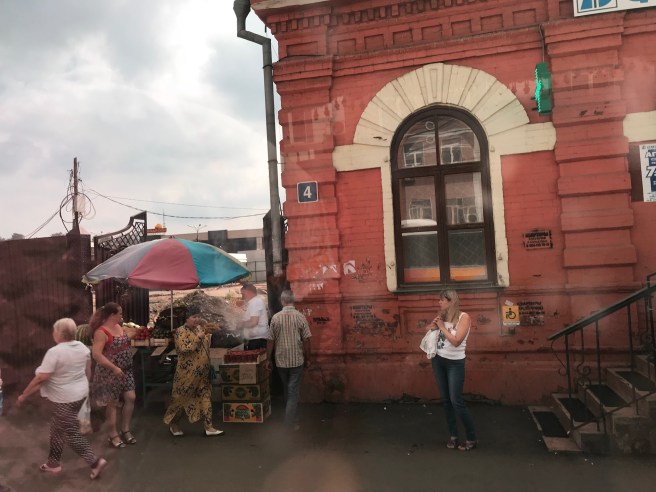
The “Paris of Siberia” is the nickname the local guides have given to Irkutsk – which sounds completely oxymoronic. Like calling it a diamond in a goats ass, right?

03A70261-1417-4A71-8841-71EC909B13CE.jpeg

But it turns out that despite the fact Siberia is frozen solid 8 months out of the year, the descendants of all those intellectuals, and Jews, and Poles, and Ukrainians, and anyone else who pissed off Stalin and found themselves on a one way train to this vast wasteland, eventually developed it, and while it’s not Paris by a long shot, Irkutsk does have its own quirky charm.

We spend our first day visiting some cute churches (Russian Orthodox – so women are given scarves to cover their heads before entering)

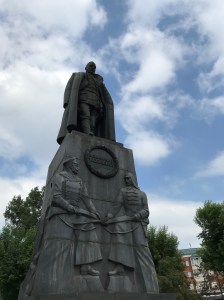
and monuments to a bunch of people that would’ve meant more to me if I were better at history.

B57C6124-061D-4BD5-89B3-07394103FE21

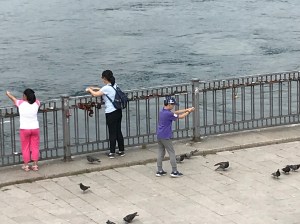
The Angara river runs through the city, and there is a promenade alongside it in the center of town where lovers have hung locks much like the bridges in Paris.

B74A3DCA-0BBD-4ECF-B76F-D60B56FBDE43

There is an area full of charming wooden houses with colorful shutters that were built in the beginning of the 20th century, most in various states of dilapidation

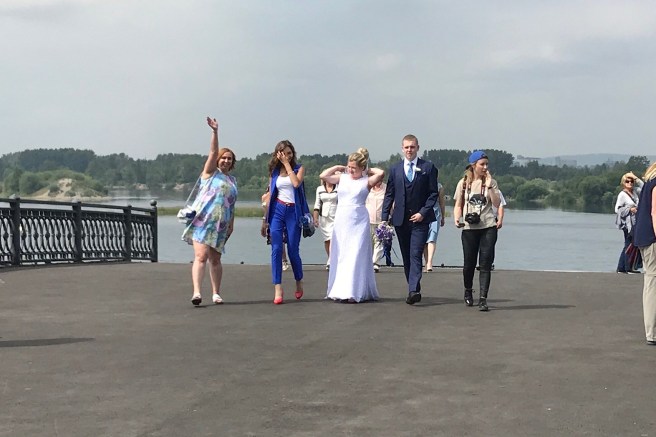
juxtaposed against some grim Soviet utilitarian style apartments. We even see a few actual Russian brides, as Friday is a big day here for weddings.

493D60DB-C678-4E4D-82C7-DFF423A34334

We dine out at a place called ‘The Bulldog.’ By and large the things we are served look and taste familiar. There is a strange fern like vegetable they use that tastes like asparagus- and a wide variety of berries, some I’ve never seen before.

And a lot of really exceptional vodka.

The next day we are up early for our trip to Lake Baikal, the largest (by volume) freshwater lake in the world. The lake is about as long as the distance from LA to San Francisco, a mile deep, and very, very cold.

We take a road that apparently only exists because of Dwight Eisenhower- Kruschev ordered it built for his visit that was cancelled due to some missile crisis (again, I am crap at history) but the people of Irkutsk are thrilled to have it as it’s the only direct route to the lake.

We pass miles and miles of forest occasionally dotted by small villages.


Siberia is one of the most sparsely populated place on the globe, given the harsh weather conditions. It’s the peak of their summer, but we are all wearing light jackets.

We stop first at the Lake Baikal museum which serves to explain the geological significance of the lake – which exists on a fault line and experiences a lot of seismic activity. There is a small aquarium with examples of sea life which amounts to a few, uninspiring (but we will later discover, tasty) smallish grey fish. There is also a chubby native seal called a Nerpa. They sell stuffed ones all over town.  There are two of them at the aquarium in a murky tank where they swim listlessly to and fro for the tourists.

Then we head down to a pier and board a boat. We see just a few boats and no other recreation at the lake, because it is so cold. Baikal freezes over in the wintertime when it becomes popular for skating, skiing, and snowmobiling, but even in the middle of summer the warmest the water gets is about 40 degrees. The lake is so large and so cold it generates its own weather, which this day was brisk and drizzly.

Still the boat ride was invigorating with views of lakeside villages and snacks and more vodka and some folk music being performed below deck.

DEFBBD0C-1515-4909-B93A-B13DE6922906

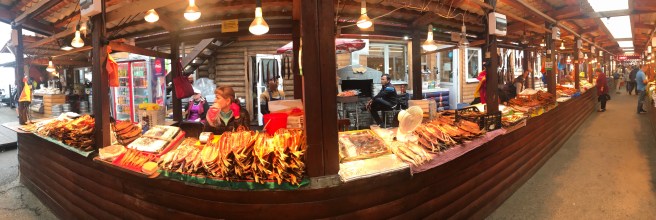
Afterwards, we visit an open marketplace where I buy some bangles. Jade comes from the river, as does a purple stone found only in Irkutsk called Charoite.

F699E053-8CE5-46A7-AE46-E4C751D6E8EF
The we have a lavish multi course lunch in a lakeside hotel. Here we try the tasty local fish which has a firm flesh and flavor a lot like salmon.

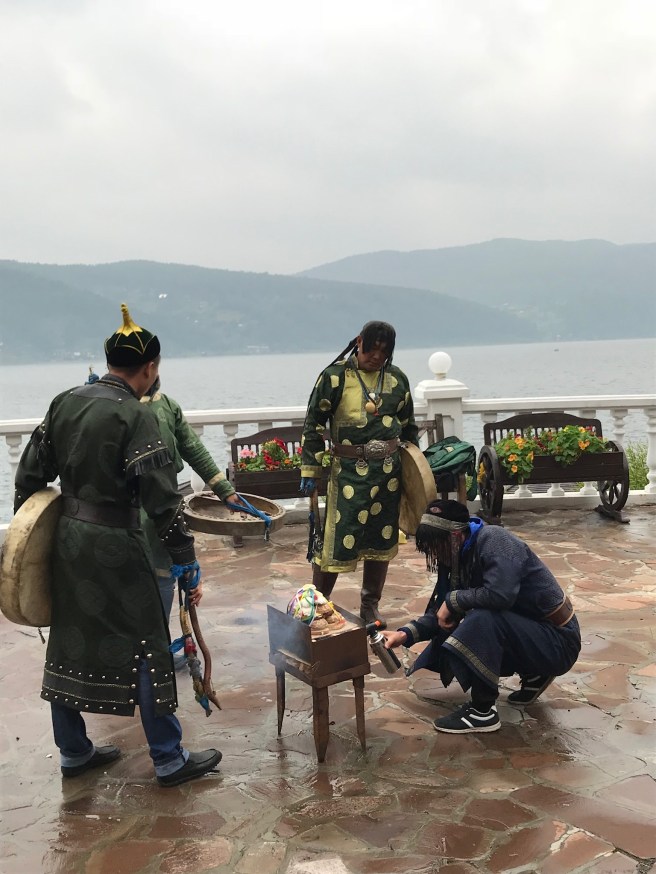
After lunch some local shaman burn what appears to be a pile of bread and foodstuffs in a hibachi grill and bang some drums offering a blessing. (I am told they burn white foods as an offering to the spirits)

C635ADF2-357B-4863-BE45-7765E4803DC8

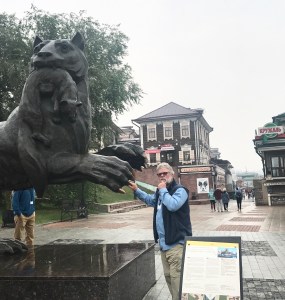
Then it’s an hour back to the hotel and a couple hours to rest before they take us first to the great statue of Babr, a storybook tiger who lives in the forests and rescues sables – so we can make a wish on its claw,

10687261-6221-4430-816F-D1BEC31696E6

then to a cute outdoor shopping area

8D72793C-73E3-4B4E-9F6D-F8B07D0C3831

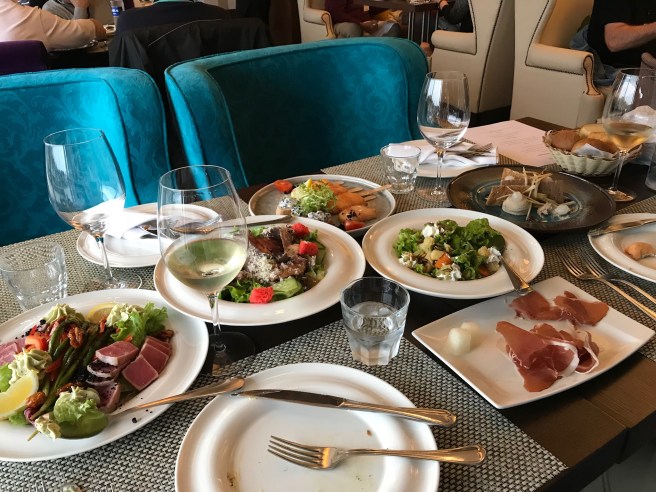
where Kevin purchases a Putin nesting doll (inside you find Yeltsin, Gorbachev, Stalin, and a wee little Lenin) and we eat at a silly place called Love Story that has live entertainment of the folk singing/pulling guests onto the floor and dancing sort. The food is very good, salads and pate and cheeses and prosciutto with melon and raw tuna and salmon.

CECCEDA4-5AA5-471E-8932-3E5595640F01

We are still full from lunch so pick at all the starters and pass on the entrees when they are offered. We also enjoy several shots of vodka, which I later learn is lower proof than US vodka.

And here I thought I’d developed an incredible Siberian capacity.

Mongolia a Go Go

After 2 flights we arrive in the Gobi desert, and a 4×4 whisks us on a 45 minute rough ride through roadless desert. The landscape is almost entirely flat and void of structure or vegetation other than very short green grass (which we later learn is a sort of chive and makes the breeze oniony) I imagine the experience to be like speeding across an American prairie circa 1800. The driver plays a lot of Bruno Mars and Bieber on the radio. Kevin asks him how long till we get to the lodge, and he says, “my name is Cougar,” which turned out to be all the English he knew.

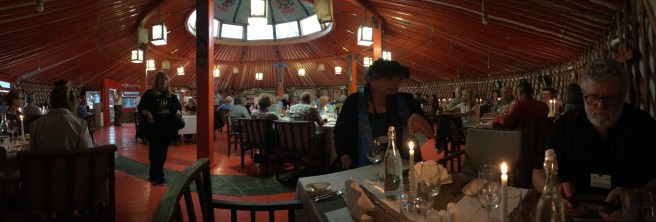
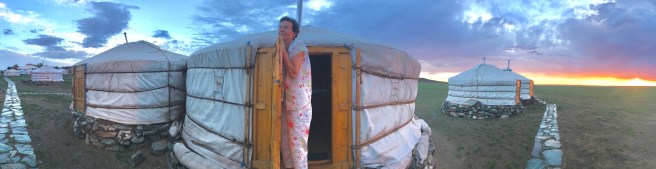
The 3 Camel Lodge turns out to be a village of gers (rhymes with beers) which is their word for yurt – round buildings of wood and felt that are the traditional home of the nomadic Mongolians, and can be erected or dismantled in less than an hour. Our unit is called reindeer, it has a bed, a few pieces of rustic furniture and a bathroom.

We have dinner in the lodge – we will eat all of our meals there, as the nearest ‘town’ is an hour away.

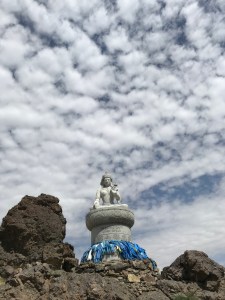
0DDBE352-CAA3-4AC9-9CB0-CFC0947B137A.jpeg

The food is simple, hearty soups, over cooked meats and plain veg.

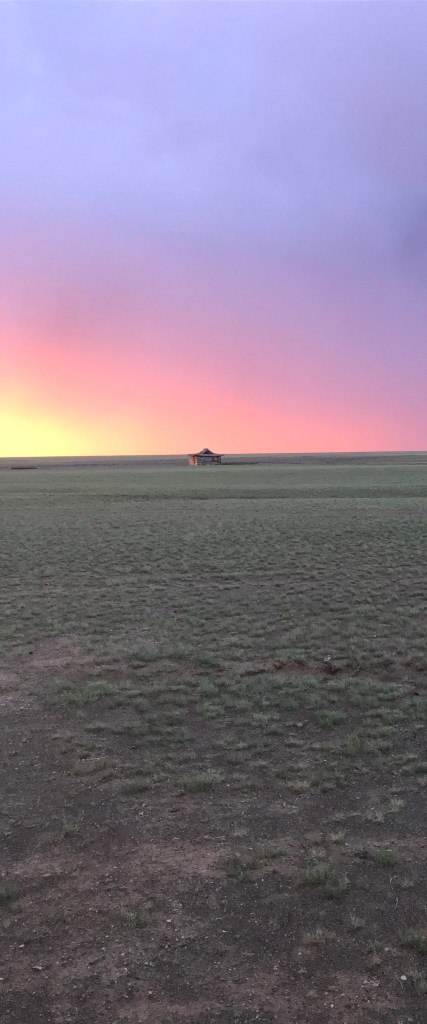
The ger is cozy, and we fall asleep quickly, but are awakened before 5am by the sounds of thunder. We will soon learn that weather changes on a dime here, but this morning I’m eager to go outside and see the storm. I am greeted with a magnificent sunrise that Kevin and I marvel over and take a gazillion photos.

236E7026-4667-4C25-AD56-B6CC3C6E49A8


The beauty of Mongolia will prove very difficult to capture in photographs – it’s so expansive and solitary.

15617883-0067-4E21-8FF4-546ED89E0E92

We spend the first half of our day taking a 2 hour walk through Lamiin Ovoo, an area of long shallow rolling hills.

36D781B8-1C6A-41D8-8143-D74145C2E227We pass several herds of grazing animals – the nomadic people support themselves with the products from their flocks of cows, horses, sheep, goats, and camels – but other than that the landscape is mostly remarkable for it’s vast blankness.

We return to the lodge for lunch and a lecture on paleontology as Mongolia is home to several spectacular discoveries of dinosaur bones and digs.

In the afternoon we travel to visit a nomadic family. Again we are in jeeps and we drive over an hour over roadless landscape – frequently there are no landmarks at all as far as the horizon and it’s hard to understand how the drivers navigate. Occasionally we drive through herds of animals, including the fluffy goats used for cashmere – the harsh cold of the steppe grows their coats exceptionally fine.

The family we visit raises camels and we are allowed to ‘ride’ them, on a lead. The Mongolian camels have 2 humps and you sit between them and hold onto the front one – it’s about as awkward as it sounds..


The mother in this family of 4 greets us, bringing us into her ger where she serves us tea with goat milk and some weird dried cheese curds they like for snack and we are also offered snuff which is pretty common in the culture. We ask some questions about their life, a typical nomadic family of 4 keeps about 600 animals.They send their children to school in the city. For a while there was an issue with children going to university and then staying in the city rather than returning to nomadic life, but in recent years that trend has reversed. To be honest, i don’t see how a person who has grown up living in this physical horizon of limitless open space could ever live in a city. Particularly as ugly and soviet era sad as the the city architecture is.

Also the nomads practice ‘sky burial’ which means they leave their dead out in places where they will be consumed by wolves and vultures and such. If a body is noticed to be consumed quickly, it means the person led a good and honest life and the earth wants them back. Conversely if the body lingers for days, they were sort of an asshole.

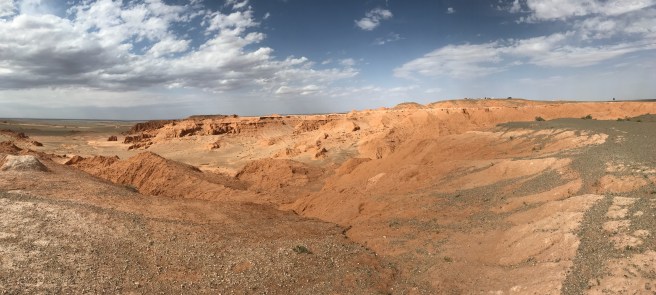
We get back in the jeeps and head for the ‘Flaming Cliffs’ a dramatic canyon of red rock where a lot of dinosaur excavation has been done and continues, and we poke around for bones.

A1B69A4D-80C6-49B6-8BC4-CA069CD17390

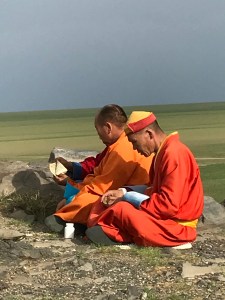
That evening as we collect for cocktail hour, a trio of llama monks chant a blessing for us.BC98858C-8323-40CD-988C-9C1D8446F9B9

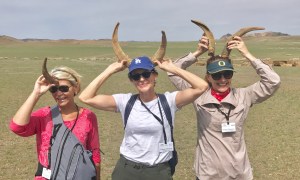
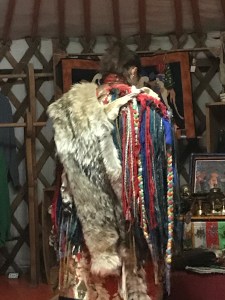
After dinner we are entertained by some local musicians and children. Following that we gather in the hospitality ger to meet a Mongul shaman – who turns out to be a pretty, college educated girl in her 20s who began having dreams and visions as a child and was called to this work, but now does it part time, as she just got a job with HP. She puts on some cray robes and dances with a drum and then a spirit speaks through her. She allows a few individuals to approach her and ask her questions.

6E39A822-96A9-41F8-AD15-DD57F9A78638

There were few takers, so I volunteered. I told her I’d been sick last year, and although I was well now, I worried that because my doctors didn’t know what caused my cancer, that it might return. She asked me (through her translator) to remove my glasses. She wore a thick fringe over her face, so i couldn’t see her eyes, but she took my hand is her strong grip for a long time. She asked me if I’d traveled to a place with large rocks (??) then after a long pause said that I was a person whose spirit was very sensitive to different places.

Which was not entirely dissimilar to what my oncologist told me – that western medicine had no idea what caused my sort of cancer, but the theory was that it was environmental. So that’s a little bit woo-woo, right?

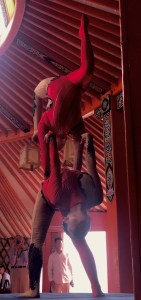
The next morning we hiked 250 steps up to a Buddhist temple high up in some pretty cliffs. D7E8174B-0681-455D-A1C3-1FFA30B0C610Then some contortionists entertained us at lunch. Apparently there are a lot of Mongolia contortionists including a meaningful percentage of the folks in circ de soleil F61FA5FB-1319-4061-A581-B747E98F7BC2

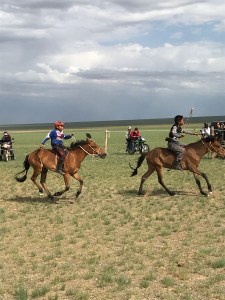
We spent the afternoon at a local festival where there was a children’s horse race, (Mongolia horses are quite small and not surprisingly the smallest children did the best including a number of girls) 66D3C92A-46BC-4031-BEFA-23624E2A7558 a wrestling tournament, and an archery competition.

It was fun cheering and mixing with the locals.


The wrestlers wear blue briefs and a long sleeve red bolero that is open in the front. We are told it didn’t used to be open, but when women began to want to compete they changed the design to keep them out. Which is sort of crummy. On the other hand, a man mountain won as they don’t have divisions or weight classes – it would take a pretty gigantic woman to compete.

That evening is a popular band called ‘Legend’ in the dining hall, who performed some throat singing which is a Mongolian thing where they make their voice sound a bit like a moog synthesizer.

That night is a wild rainstorm and the morning drive back to the airport is a wild one, muddy and slippery and lots of fish-tailing.

2691FF57-94E4-491B-B020-C725C0A0551F.jpeg

Baking in Kyoto and Nara


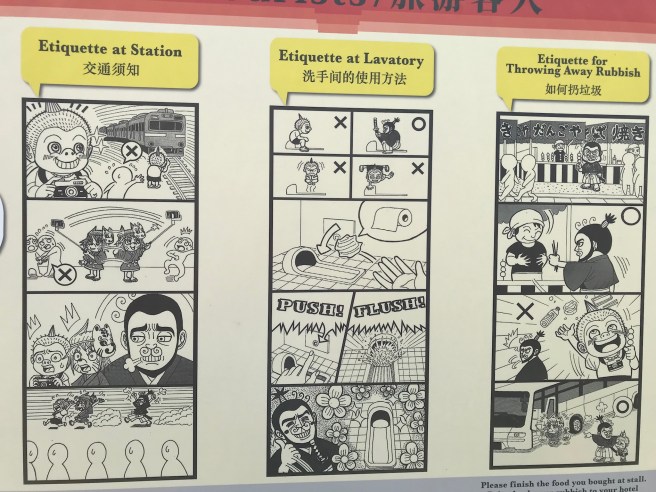
Maybe you know a lot about Japan – in which case some of the things that surprised me about this country will sound laughably ignorant. Like despite being only about the size of California, it’s population is equal to half that of the US. And much of its land is not inhabitable (too mountainous, needed for agriculture) so folks are packed in pretty tight and there are a lot of strict rules about cars and such. Cremation is strongly recommended to the populace, if you opt for burial, they have to break some bones so you can fit into a small barrel they use instead of a casket, and everyone in the family goes into the same grave. It is incredibly clean, the people are very health conscious, and the toilets are hilarious and “medical” according to our guide.

There are plenty of signs everywhere to tell you how to behave.

C567D8BC-9A6E-4C37-92FC-460C316E83BD

Kyoto is its prettiest large city, and former capital. It’s full of shrines and temples and parks. During the time we’ve been here, it’s been intolerably hot.  Daytime temps are well over 100 degrees with humidity thick as pudding. Several heat related deaths are reported in the newspaper. Our guides circulate with fans, water, salt candy, damp cloths, and cold compressed air in a can.

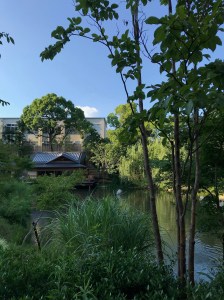
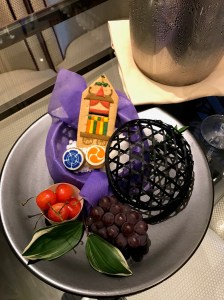
That being said, the Four Seasons in Kyoto where they stashed us is spectacular. We look out on a tea garden 949BCEF8-6993-439E-9339-F7F81B340B5E  And the cookies they bring us look like jewelry

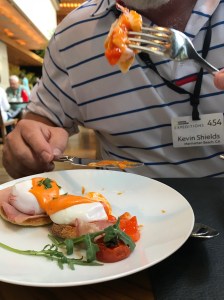
B0AC86F4-70EF-4F31-BB62-B5158C85CE10 Although the eggs Benedict at breakfast was a bit VIVID, even for Kev who generally has been able to eat any preparation724F41E2-B0C3-4989-8FA2-2892BC373BE9

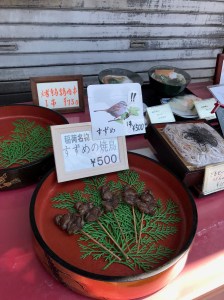
And neither of use went for the sparrows on a skewer we saw in the marketplace, which is really just an efficient way to dispose of the sparrows who are a pest to the rice farmers 9219004D-E29E-45C9-9E1B-F947FAF3613D

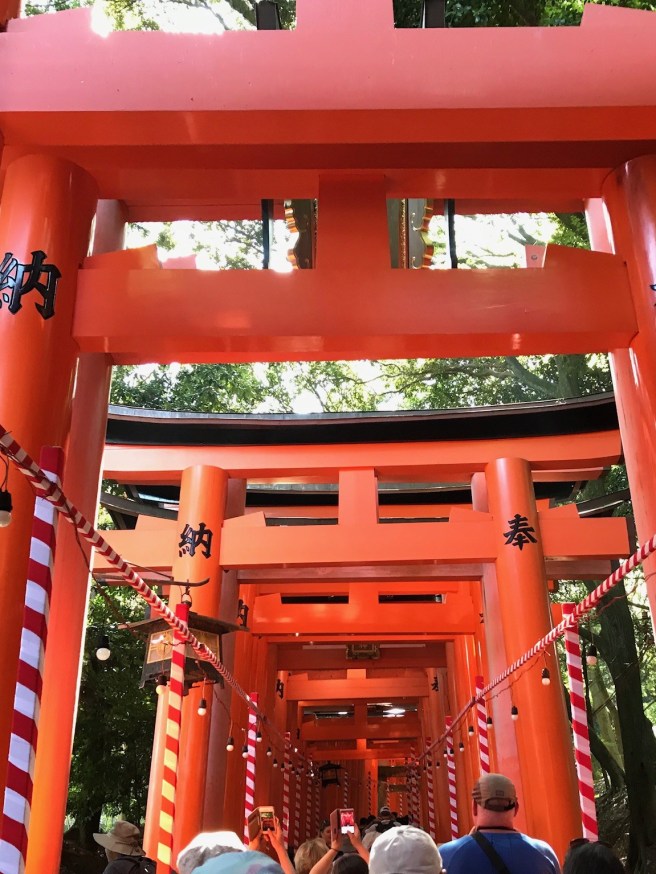
There are several spectacular sites, including the 10,000 Torii gates up to the Fushimi  Inari shrine.

d186de8c-2b21-47f5-94fd-caf523353470.jpeg

We made an offering to the Shinto God of that shrine -which looked like a fox and had something to do with commerce. There are like a million Shinto Gods and they each have their own specialty, although there is no Shinto ‘bible’ or holy book and the religion seems to be mostly about making wishes for good luck and offerings (usually saki) to ward off bad luck. The Japanese are big believers in luck. Wishes are written down on all sort of combustibles and later burned by the priests. And there is a protocol of purification that looks like this:


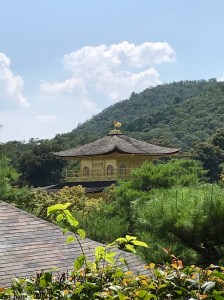
There areA12232AD-0B37-4AE7-B153-F320A011AC9Balso a lot of Buddhist templesD1764916-F19C-4146-971D-D79B7946CF72 which is sort of ironic because Shinto shrines are where you go to request your hearts desire, and Buddhism is where you go to achieve freedom from desire. Each shrine and temple we visit we has been rebuilt. It seems every building in Japan has been a victim of natural disaster, earthquakes, volcanoes, tsunamis, fires (everything is built of wood which = FUEL) This golden temple Kinkakuji above was burned to the ground by a crazy monk who was imprisoned and his mother committed suicide out of shame. Because that’s what mothers do.

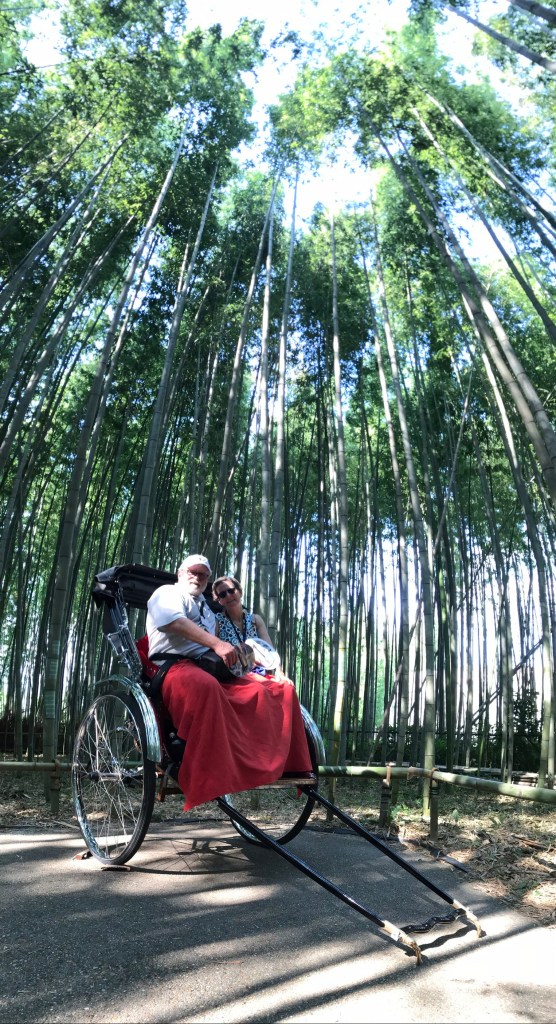
We take a hot, sweaty rickshaw ride through the bamboo forest

AB5CDAEE-FEB2-4B70-883B-BBE7476CCFD3

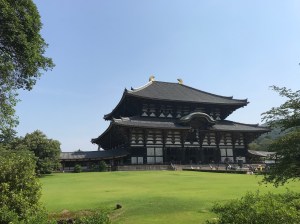
We go to Nara, where the shrine is ‘guarded’ by some very aggressive deer


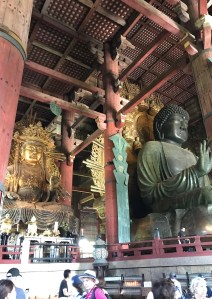
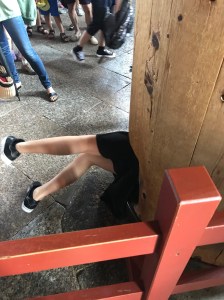
Inside the temple are wondrous statues5CF0ED6C-326C-47F0-808B-FFF33C187628 and a tunnel you can crawl through to gain enlightenment – which had a long line so you could do this: 72792C86-3FEE-4357-83DA-17453AA5CBC0


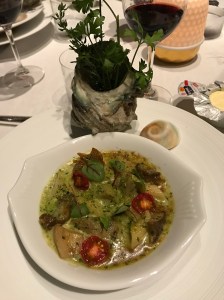
We eat some interesting things03704FEB-D3A1-4C9A-B55F-F05D8C028C5D. This is conch. (It is not sparrow)

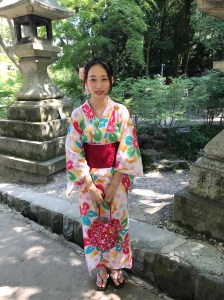
Finally a word on GEISHAS. We saw several young women dressed in full geisha regalia (despite the terible heat) at all the famous shrines and temples. It has become trendy for young Japanese women to dress up and take selfies this way. Think of all the US girls wearing non-clothes and pouting like Kardashians. Same diff. There are kimono rental shops near all the national monuments catering to them – they even do make-up and hair. For example this:

7CEBE976-A9F4-4320-80ED-BDD6E54E35A3Not a geisha. According to our guide, not even Japanese.

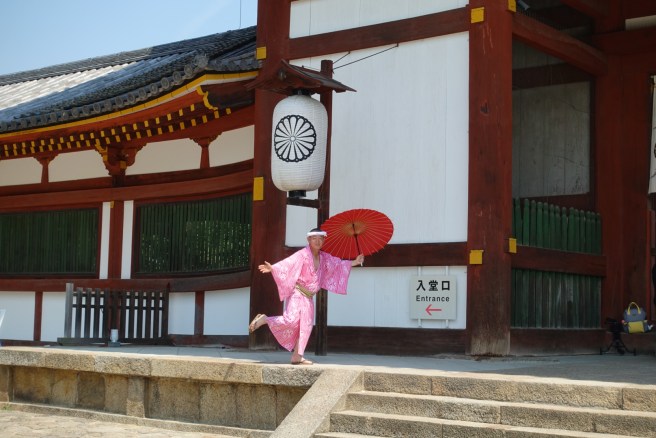
This: 4F4D518E-3F6B-4522-BC45-53D4FDF38A59

Also not geisha. In fact it’s a man.

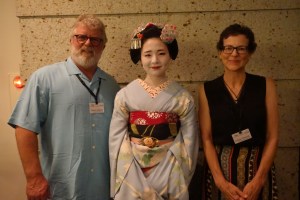
This: 65E93F4C-09AF-44C1-A7D7-11809DB33A3F is a geisha (the one in the middle – I know…hard to tell us apart) A contemporary geisha is something like being a professional cheerleader in USA. They are rarely seen in public – and work mostly private events, many for businessmen. The hair and make-up take hours and you have to learn a ton of choreography. The career lasts as long as you are young and pretty, and the pay is not great. The unspoken hope is that you marry rich. But geishas start their career as a “maiko” when they are around 14 (high school is not compulsory) which is just nuts. If I made a career decision at fourteen, I would also choose one that allowed me to put big sparkly things in my hair. Who wouldn’t?

The white makeup is because Japanese (particularly older Japanese) are obsessed with keeping their skin pale. On the hottest days women, middle-aged and older, wear long sleeves and gloves. Some even wore full on Handmaids Tale bonnets.

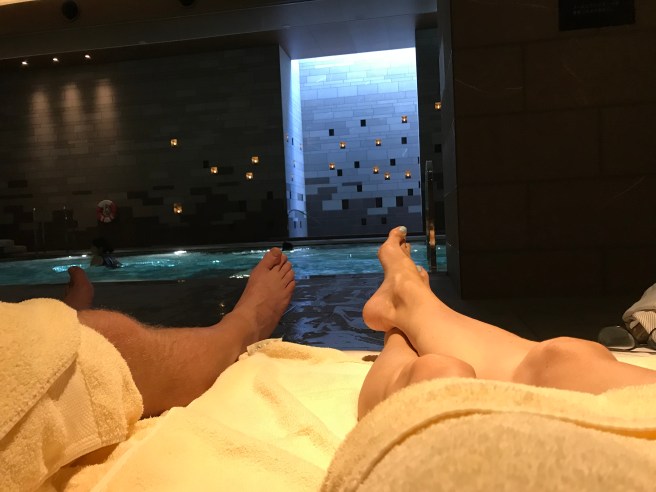
We, on the other hand, ended our day here.   It was swell. 3D080C4B-A6E0-4D93-AD3C-C999CF935892


We Go Round the World Again

The summer after we last went round the world with National Geographic,  and I started this blog, my twin children got married. Not to each other – we are not carny folk – but to lovely people.

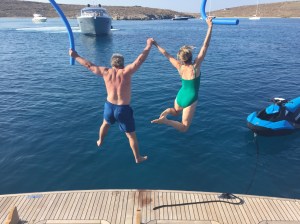
As if that weren’t swell enough, we also went boating in Greece with Kevin’s girls. It was a truly great summer.

7534647E-5876-4700-8B05-1D5DAE8D5E47

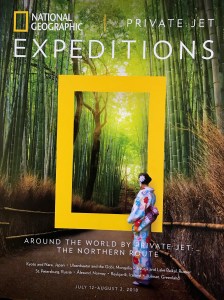
The following summer, which was last summer, I was diagnosed with breast cancer. And that was shitty. Really, really shitty. And in the midst of all the horror, I received a brochure in the mail for a new roundtheworld NatGeo trip, and I thought, this new trip will happen in a year- I will either be dead, or be able to see some new places. Places I’ve never been.

BCEE0FDF-C1A6-4FA1-9C71-132F807ACACE

An honest to goodness kickthebucketlist. Of places in the NORTH. (I know…feels very, “AND WINTER is coming.” But I am sucker for a GOT aphorism)

So here we are. Headed to Japan first, then North of the 45th parallel for the rest of the trip. Which means the sun will never set. And temps will drop. And maybe I can stop sweating this July of 2018 which recently has been quite sweaty.

Right now we are in Seattle. Which Kev and I have both visited, but not together, and not for several years. We walked to Pikes farmers market – and got ice cream and watched the Ferris wheel.


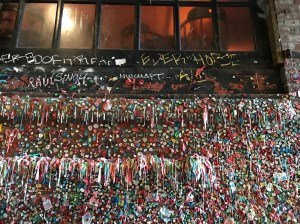
We also (accidentally) walked through the alley of gum-on-walls…which likely has a name but…really??? Most shocking were the droves of tourists posing in front of masticated bleh like it was the Mona Lisa.

4FB3644F-AF75-4ED1-A5C1-2FDFD24D95D1

Don’t go! I need to believe in humanity.

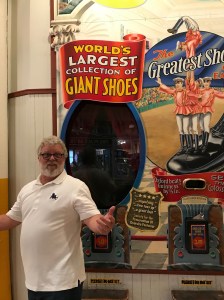
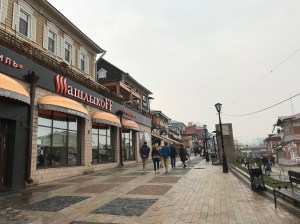
Also in the interest of NOT MISSING a thing – we put 50 cents in a machine that showed us large shoes. Which proves a sucker is born every minute, and he has no problem asking his wife for 2 quarters.
B4979E42-E4D3-4FFA-970D-C19B923A7D46

Then to Elliot’s for oysters and wine before returning to the hotel for some preflight instruction and more wine.

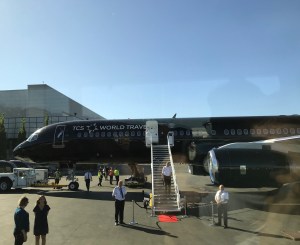
Tomorrow we head out on this fancy black airplane and I feel just like Morgan Freeman in Shawshank when he decided to violate his parole and go find Andy on that bus, and he said,

”I find I’m so excited I can barely sit still or hold a thought in my head. I think it’s the excitement only a free man can feel, a free man at the start of a long journey whose conclusion is uncertain.”

429F556D-910B-4D8C-AAF5-051F44E4891D.

Our first stop is Kyoto which is predicted to be hot enough to melt a geisha’s face.


The End of the Road in Morocco

By the time we get to our final destination, I am burnt out. Toast. Both ends of my candle snuffed at the nubby wick.

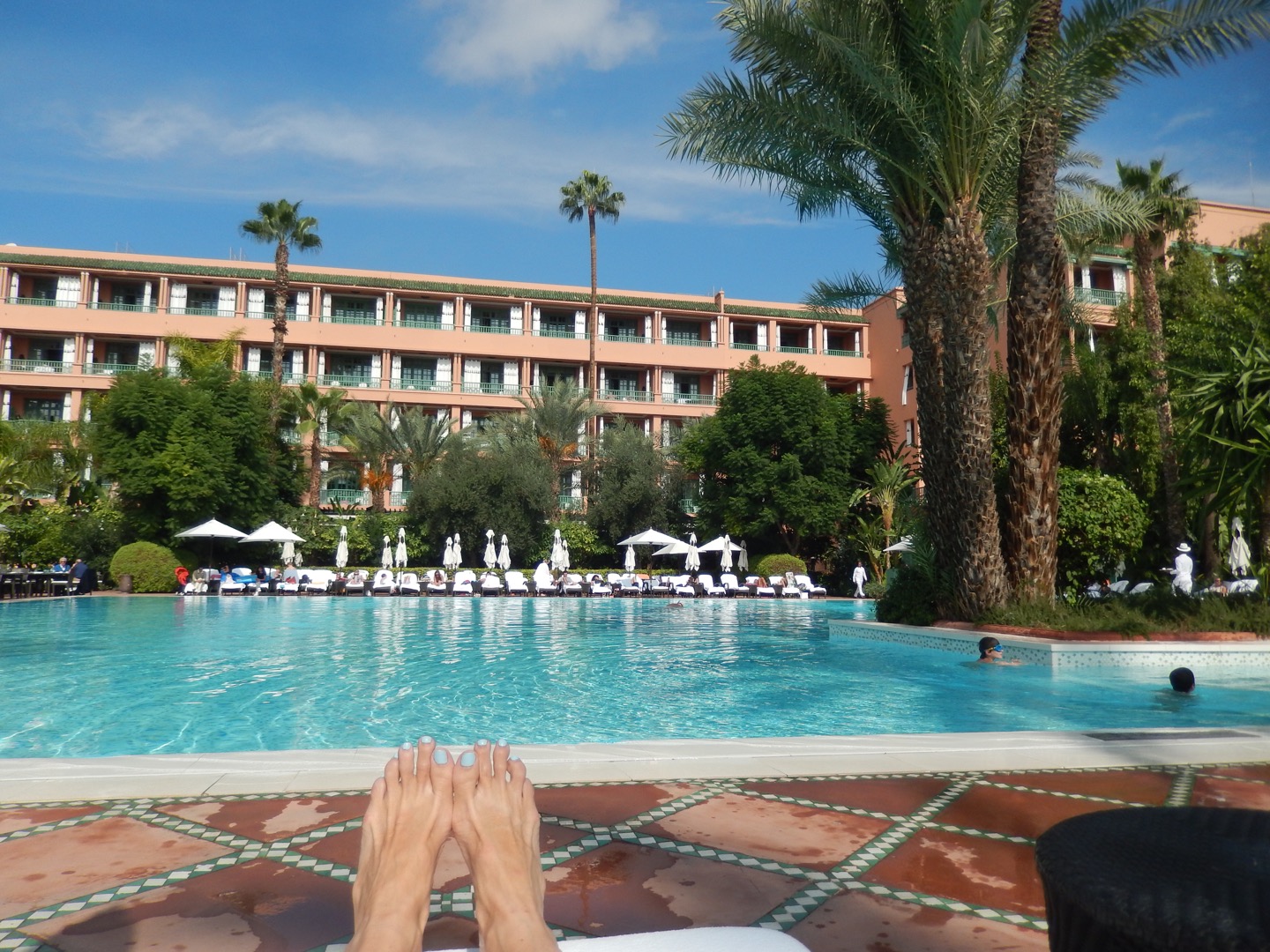
Happily, I’ve been to Marrakech before. I’ve even been to our hotel, an over the top posh palace called la Mamounia where I dined one evening on my previous trip in their fancy restaurant.
So I have no guilt or regret about skipping the morning tour of mosques and monuments, certain that if one more well-meaning guide explains when or why or how or by whom an edifice was built, I will jump from the ledge of said edifice. It is enough. So many dates and places and extinct civilizations jumbled in my brain with Moai and Masai and Moghuls.
The evening we arrive, we have a quick dinner in the hotel’s Italian restaurant (knowing we will have 2 large Moroccan meals the following day). Aside from the breakfast pastries, which are a marvel, most of the food we eat at la Mamounia is fancy but tourist bland, which is fine since my tummy is STILL a bit delicate, and I am actually quite fond of the sweet, smoky flavors of a good Moroccan tagine. If the hotel food were better, I might get myself into trouble again.
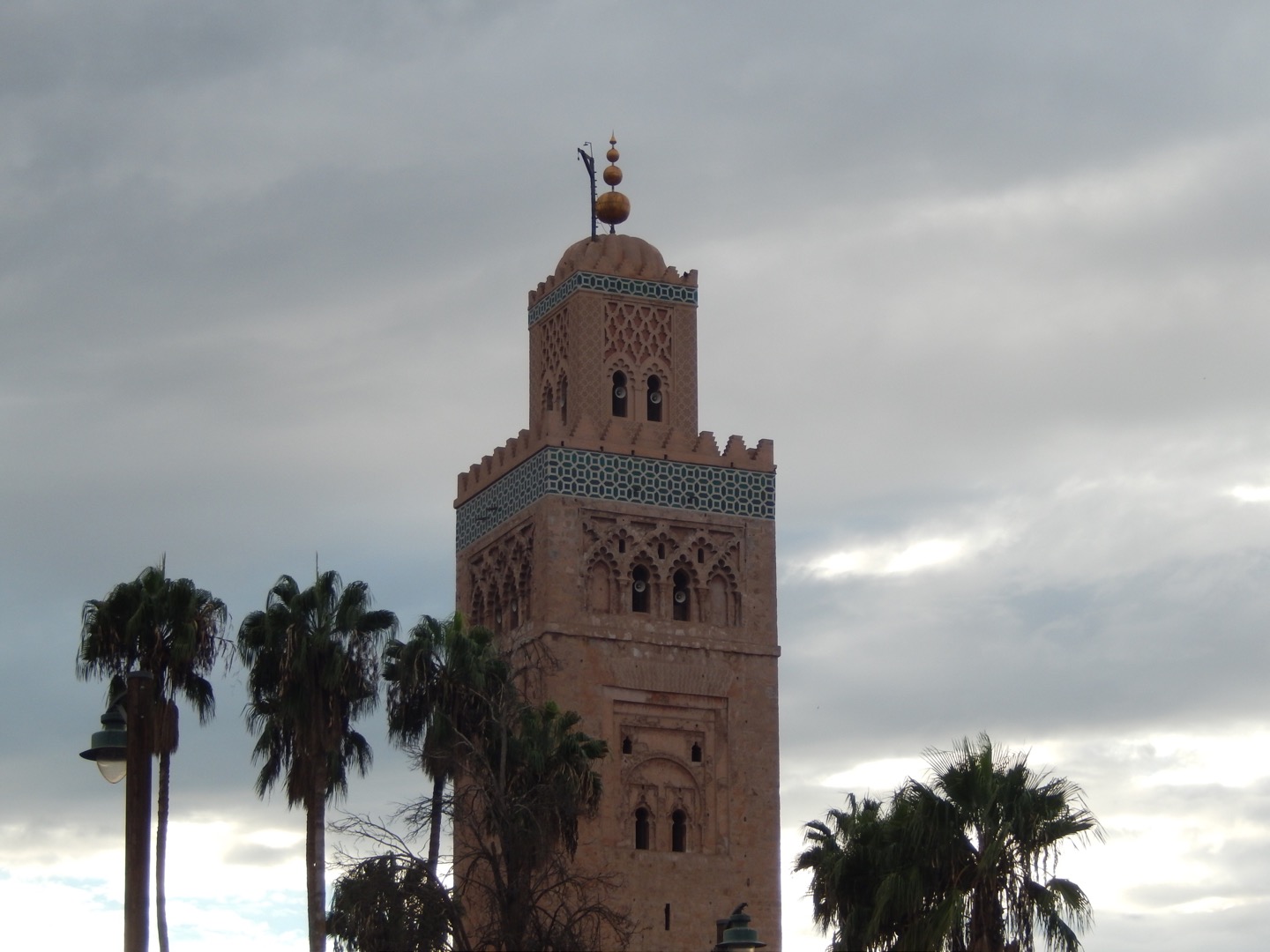
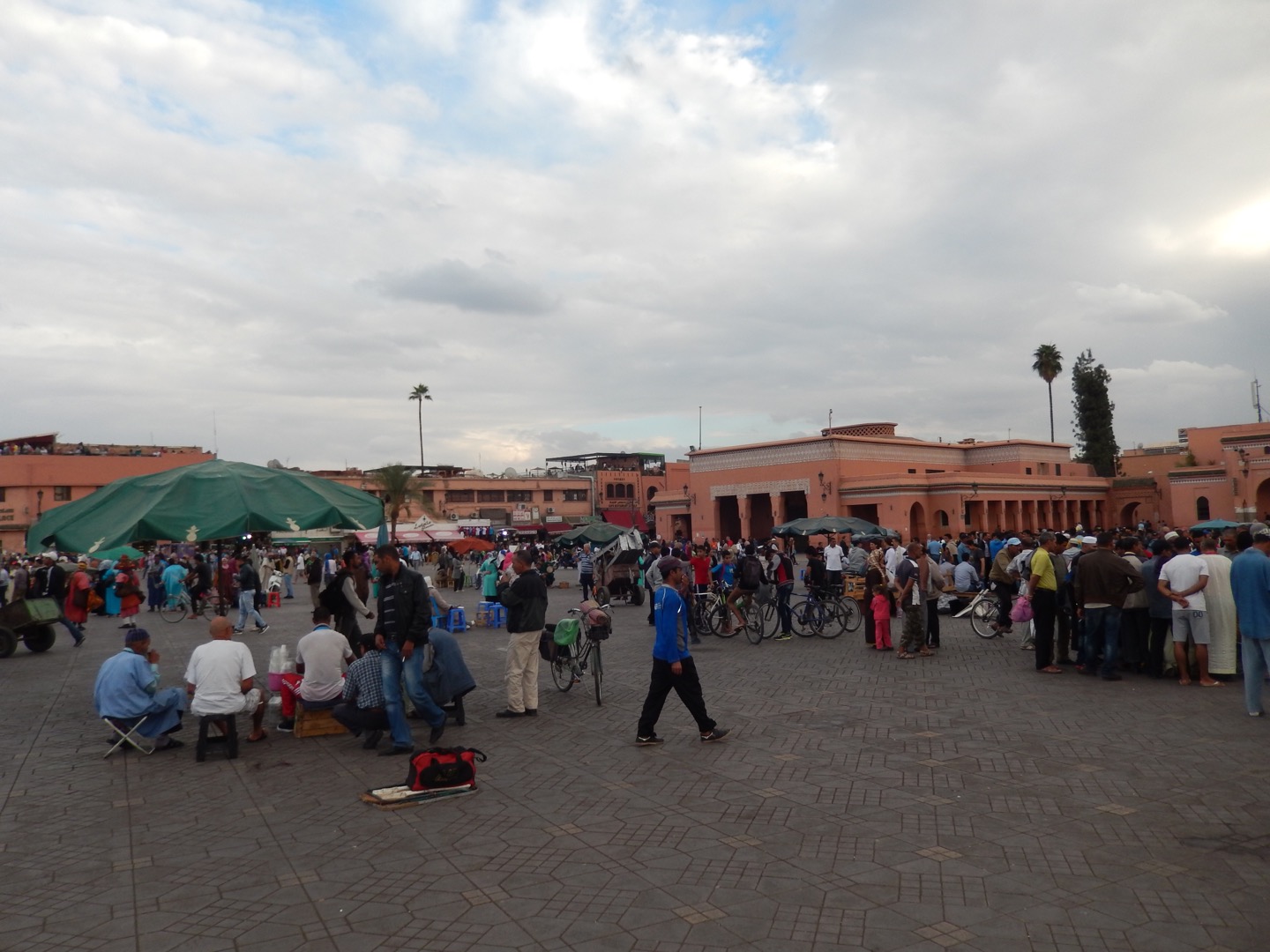
Then we decide to go rogue. A guide has been arranged to take us to the Djemaa el-Fna square, and feeling confident we can navigate our own way, we break away from the pack and are soon AWOL. It sounds ridiculous, but after days of rigorous structure, I just want to get a little bit lost. Also, you cannot actually get lost going from the hotel to the square, as the beautiful well-lit tower of the central mosque operates as an easy landmark. imageIn fact the only hazard we face is crossing the street; traffic is madness and there are no stop lights. You just wait on a corner until joined by enough people that the cars and scooters and buses and horse carriages will be forced to go around you. Safety in numbers.
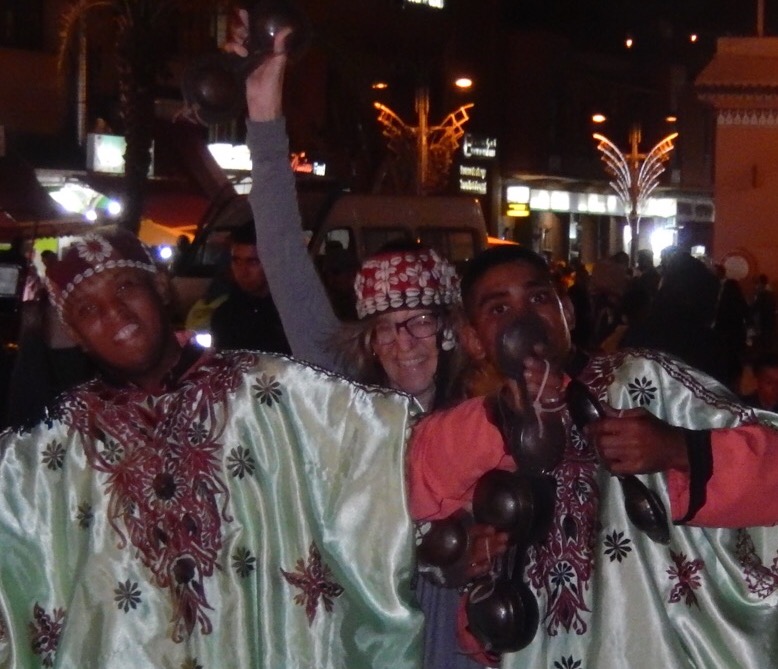
It’s a warm, drizzly night, the recent rain raising an eye-watering stench from the horse carts as we pass them on the way in, but despite the dampness, the square is packed with dancers and musicians and vendors and food carts and fortune tellers and artists. We’ve each been given a small bag of coins by our NatGeo handlers, because if you so much as pause to listen or watch a performance, or snap a photo of local character, someone will appear at your elbow and aggressively pass the hat.
I am pulled into a dance with these guys. image
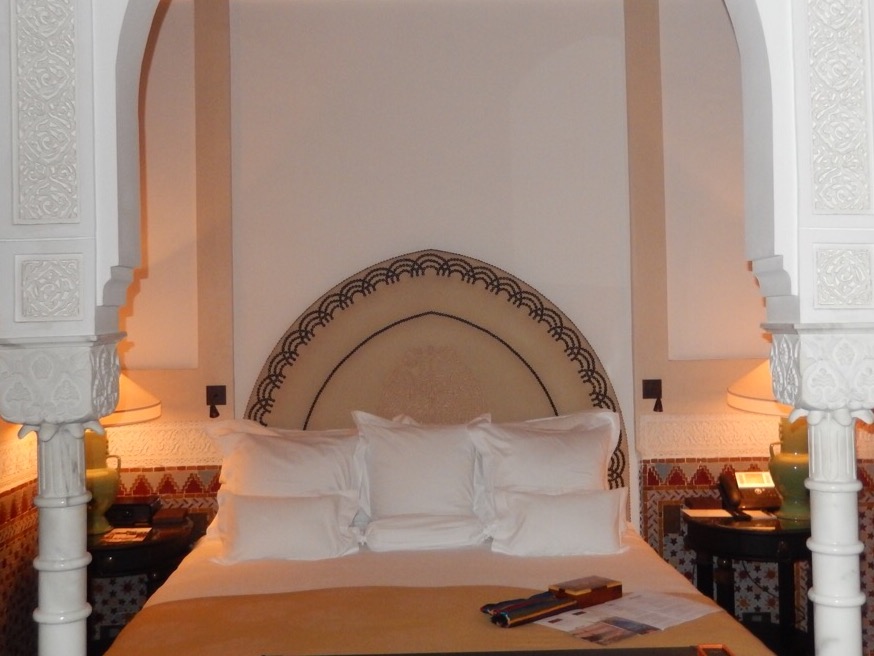
Soon we drift back to the hotel, and our cozy room, and a long night’s sleep on excellent sheets. imageWe awaken to the sound of birdsong, as opposed to an alarm, and sloth about, ordering room service coffee and pastries. Kevin’s back has been troubling him, so we venture out to the nearest pharmacy, where after some broken French (mine) and broken English (pharmacists) we purchase some Moroccan-style ibuprofen.
Then we make a long, lazy tour of the hotel property, which has an art exhibit going on of whimsical animal statues image(incl a lot of French Bulldogs) an opulent spa and hamman, and extensive gardens, before parking ourselves at one of the pools.image
After our (Big Moroccan Buffet!) lunch, Kev decides to skip the afternoon tour options in favor of a trip back to the spa for a long massage.
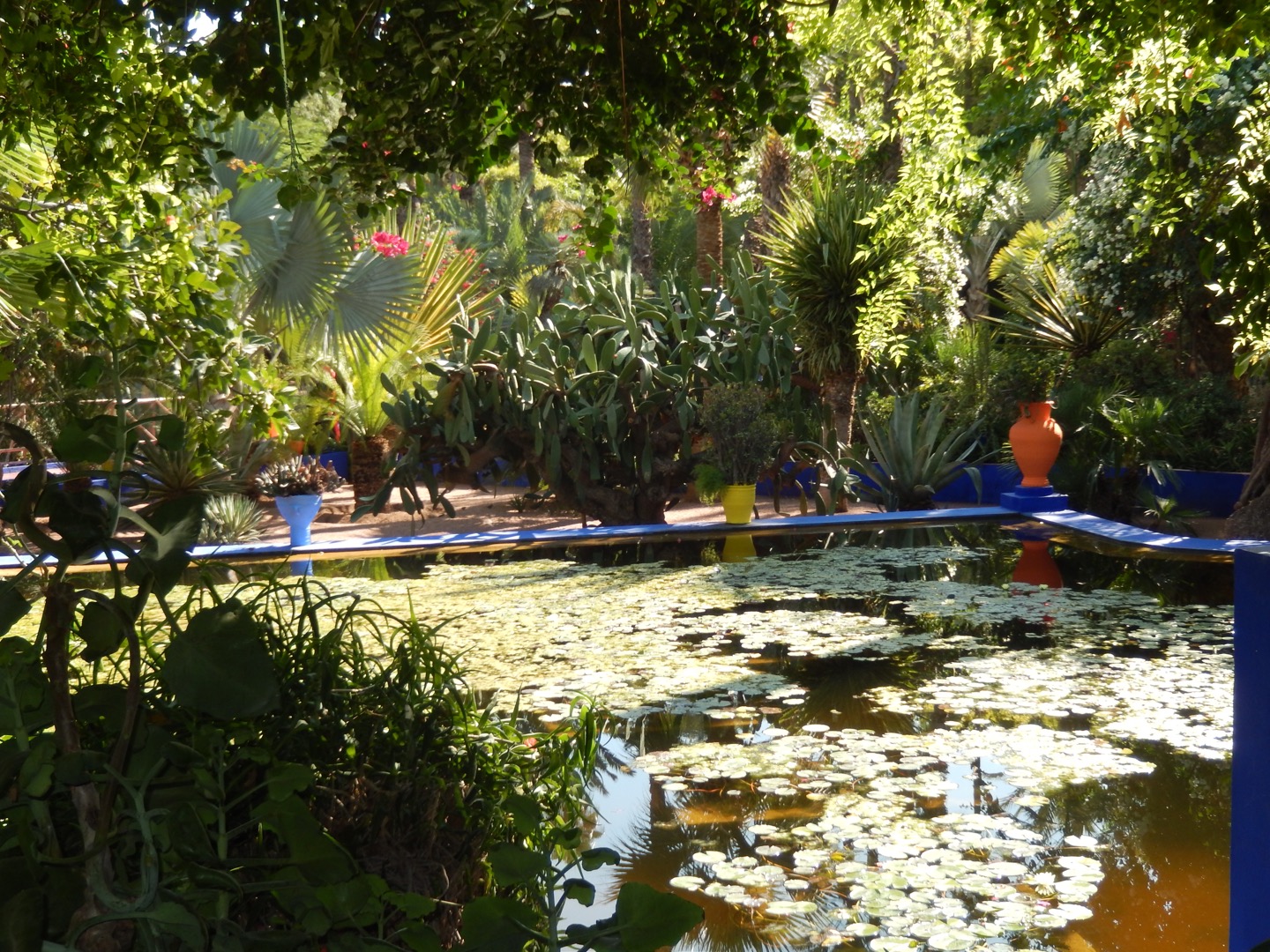
But I join some tour friends in a horse drawn caleche to the Majorelle gardens, a twenty minute ride located in Gueliz, The modern part of Marrakech. Here you see more people in western dress, and fewer women wearing the hijab. The gardens were famously first created by the artist Jacque Majorelle in the 1920’s. imageAfter his passing they fell into disrepair, but were later purchased and restored to their current glory by Yve St Laurent in the 80’s, who maintained a home on the grounds with his partner until his death (and has his ashes scattered here). Now they are open to the public, alongside a small Berber museum featuring elaborate jewelry and handicrafts and also creepy cloaks and headdresses and daggers which you are not allowed to photograph (just as well).
When I return, Kevin is happily splashing about in the pool, but realizing we have just over an hour left before the evening farewell festivities begin, and we have not yet even entered the souk (which would be a crime, as it is the coolest thing in this city) we make a quick turnaround and head out.image
In front of the hotel we are greeted by a tall, gangly kid who says he remembers us from the hotel, as he works there, but his shift just ended and he is on his way to the souk to buy some argan oil for his mother. Neither of us remember this kid from the hotel, and his story smells like bullshit, but we are in a hurry are pretty sure his entire scam amounts to nothing more than picking up tourists from the nice hotel and leading them to shops in the souk from which he receives a cut of what they purchase. image

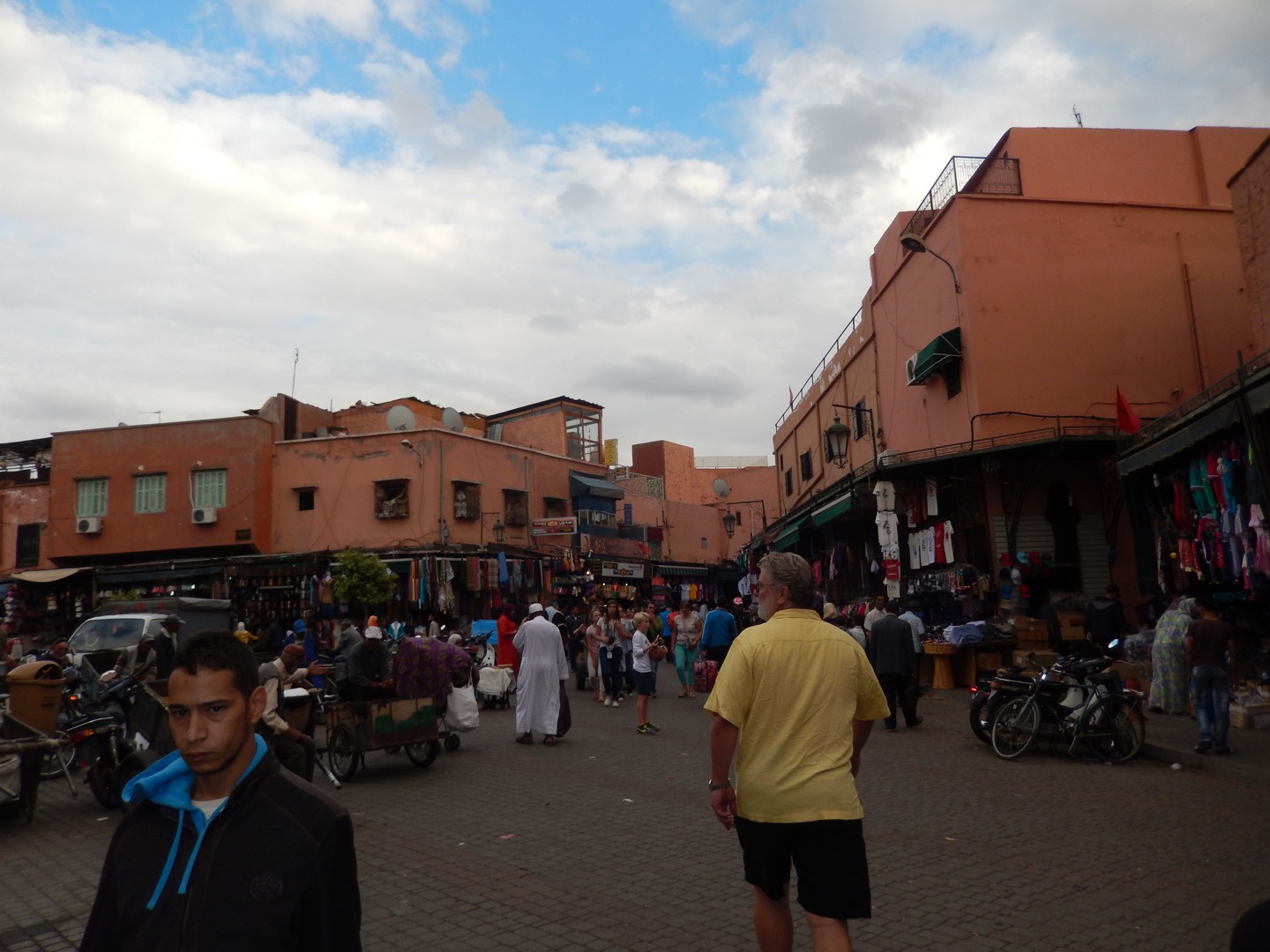
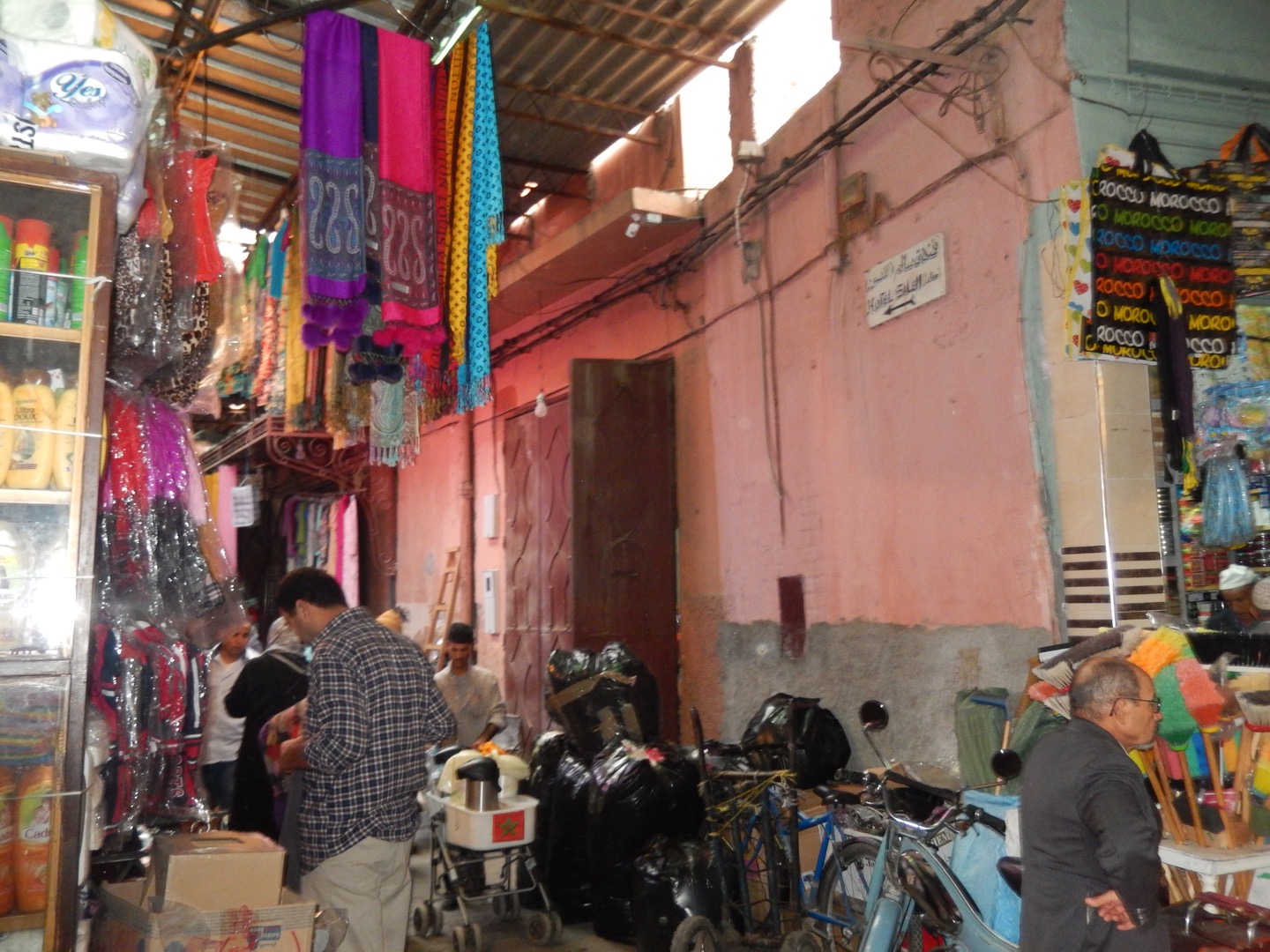
This actually completely works for us, as the souk is a labyrinth of crooked, narrow nameless alleyways, branching into even narrower corridors, with literally hundreds of stalls, some of which are identical to other stalls, the path between them teaming with chaotic humanity.image

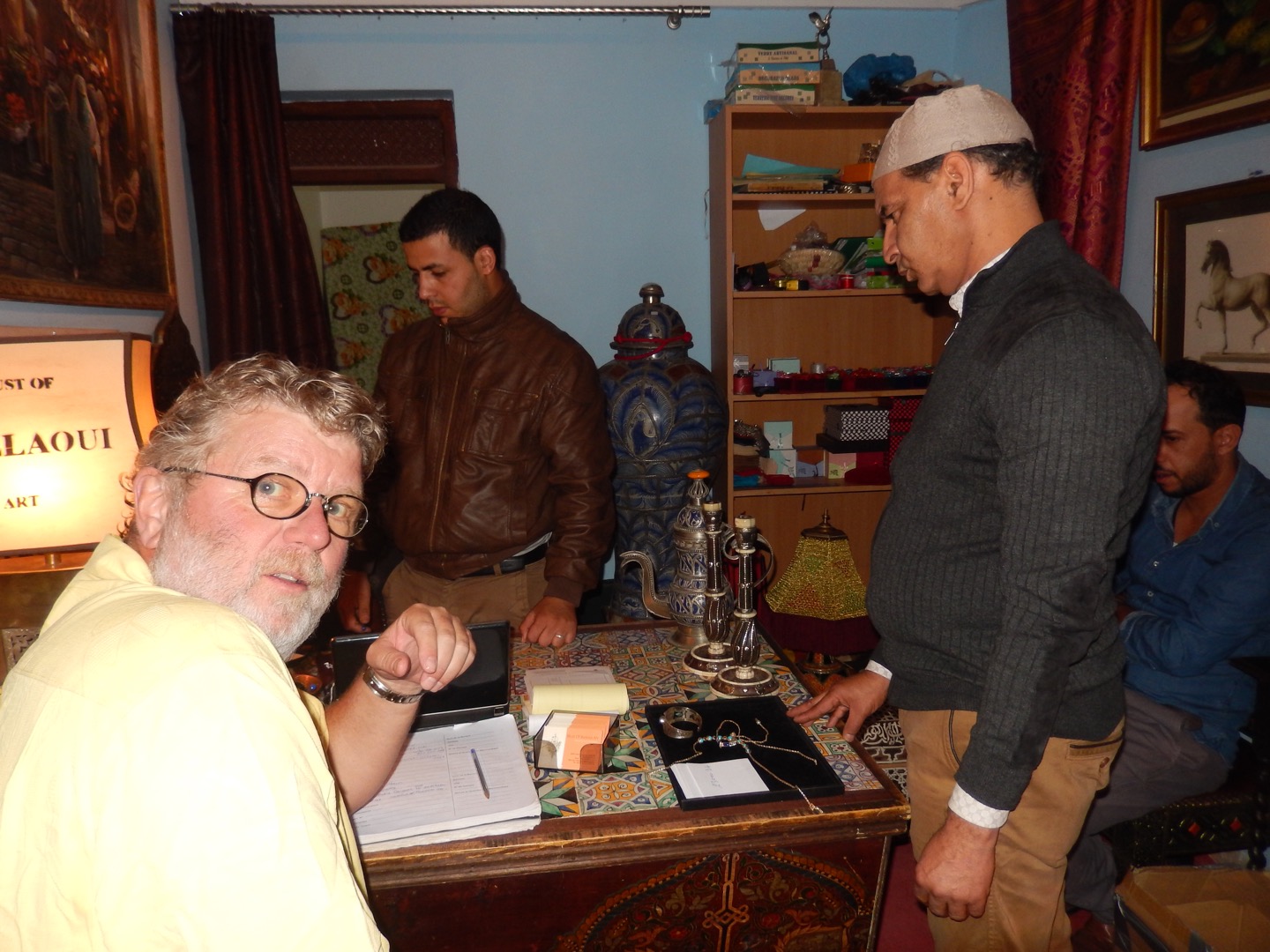
It is nearly impossible to keep your bearings and we don’t have time to wander about for hours until we find our way out. So we go along with his story, willing pigeons, and we are rewarded with being led beyond the junkier souvenir stalls near the entrance to a tiny four story house in a tucked away corner that functions as an antique shop dealing in Berber furniture and jewelry and crafts. It is a charming jewel box of a store, and we’d never have stumbled upon it on our own. We buy a few small things imageand our young guide then escorts us back to a point from which we can find our own way (guided by the mosque tower) before he heads back in to buy his mother that argan oil, which maybe he wasn’t bullshitting about after all.
That evening we gather for our farewell dinner. Everyone has been told to wear something they picked up during our travels, and I have on the pretty lapis and silver necklace and turquoise and coral bracelet that we purchased moments earlier in the souk. We are entertained with a slide show (put together by the staff photographer) of the places we’ve been and things we have done, followed by a lavish feast of good (but not great) Moroccan fare. Then some not entirely convincing belly dancers (dead-eyed, bleached, hipless) perform, after which we call it a night. It is time to pack for our final flight. It is time to go home.
That night I dream I am walking through my door. My sweet, old dog is there to greet me, wagging his tail so hard–the way he does when he is excited–that he can’t walk straight. And I am overjoyed.

Petra-fied

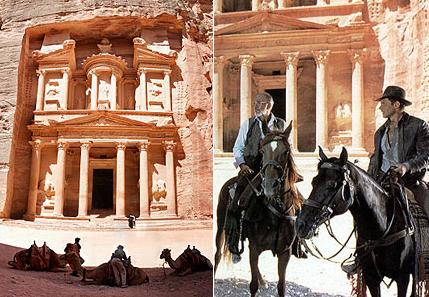
When most Americans think of Petra, if they think of it at all, it’s probably because of this scene from Indiana Jones and the Last Crusade. image
But Petra is one of the seven wonders of the modern world, alongside the Taj Mahal and Great Wall of China, it just doesn’t get as much press.
Petra lies in Jordan, a small middle-eastern country that neighbors Saudi Arabia, Egypt, and Syria. As you might guess, the current political climate has taken a toll on tourism here. On one level, this was our gain, as the Petra site, usually overrun by tourists, was not crowded at all. On the other hand, about half of the high-end hotels have had to shut their doors for lack of business, and the souvenir vendors have become exceedingly aggressive.
Oh yes, and the tourist buses each have a cop….with a gun.
We are booked into the Movenpick hotel, a Swiss chain, nice but not fancy, chosen for its prime location just steps from the entrance to the site. We arrive late and get a quick bite in the bar before turning in, a little mezze plate with hummus and toubouli and pita. I’ve been experiencing some tummy trouble since India, and had attempted to mind-over-matter this by eating the American style food that I craved while in Tanzania. But in Africa, not even the Four Seasons can make a cheeseburger that tastes anything like home, and don’t even get me started on the room service pizza with oddly cardboard crust and ketchupy sauce. My tummy did not improve, it continues to be unhappy and occasionally stabby, so I may as well eat the local fare (heavy on the rice) while popping Pepto Bismol tablets.
We opt for the early hike to Petra, before the sun really starts blazing. The town, like all the towns we visit or drive through in Jordan, is not pretty. The landscape is dry and dusty and rocky – the homes boxy, the vegetation spindly. But even the approach to Petra is pretty magnificent. image  The red rock mountain, upon closer inspection, are a million colors, the swirling patterns of which look like a melting chocolate Sacher torte. image
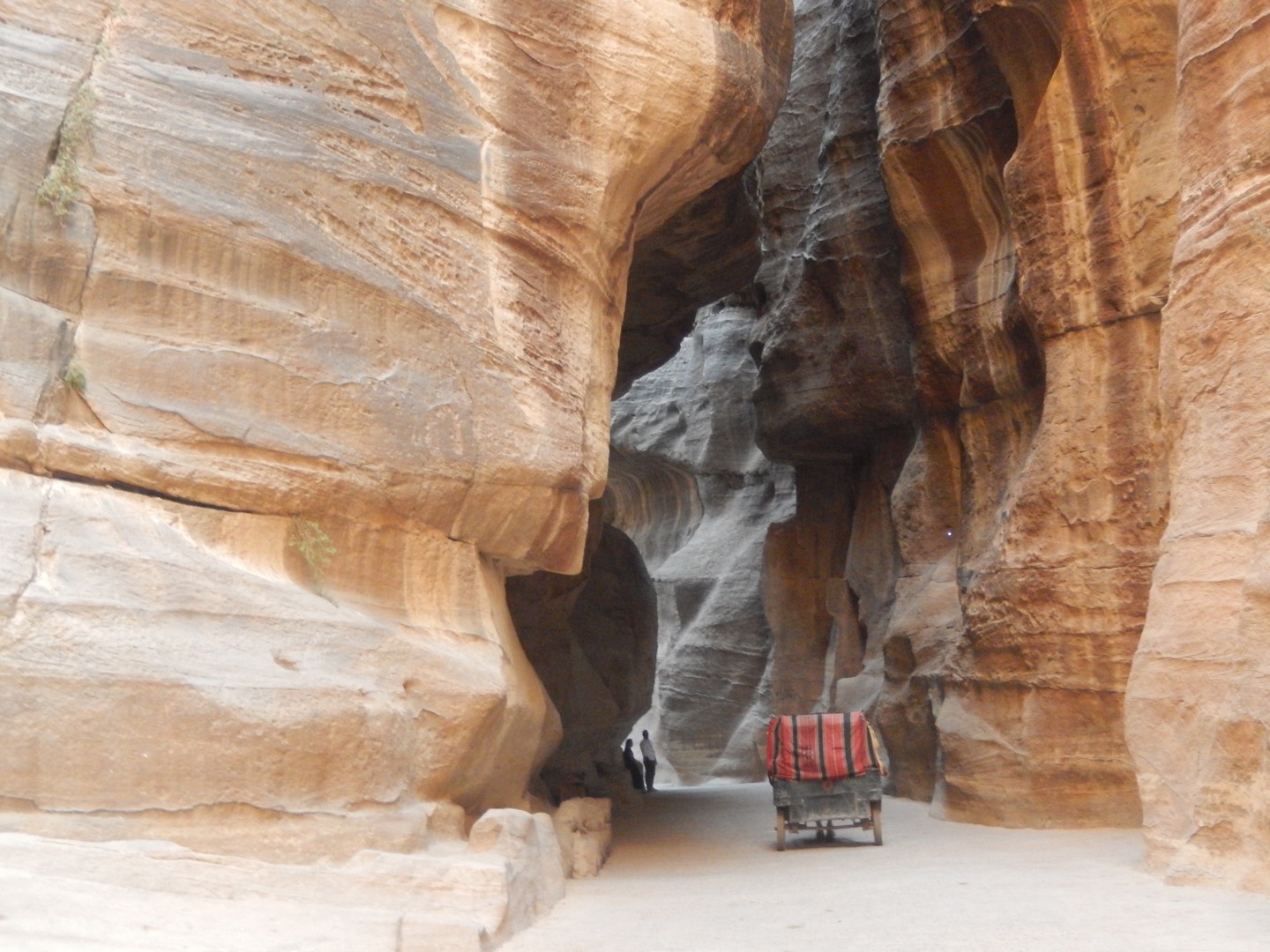
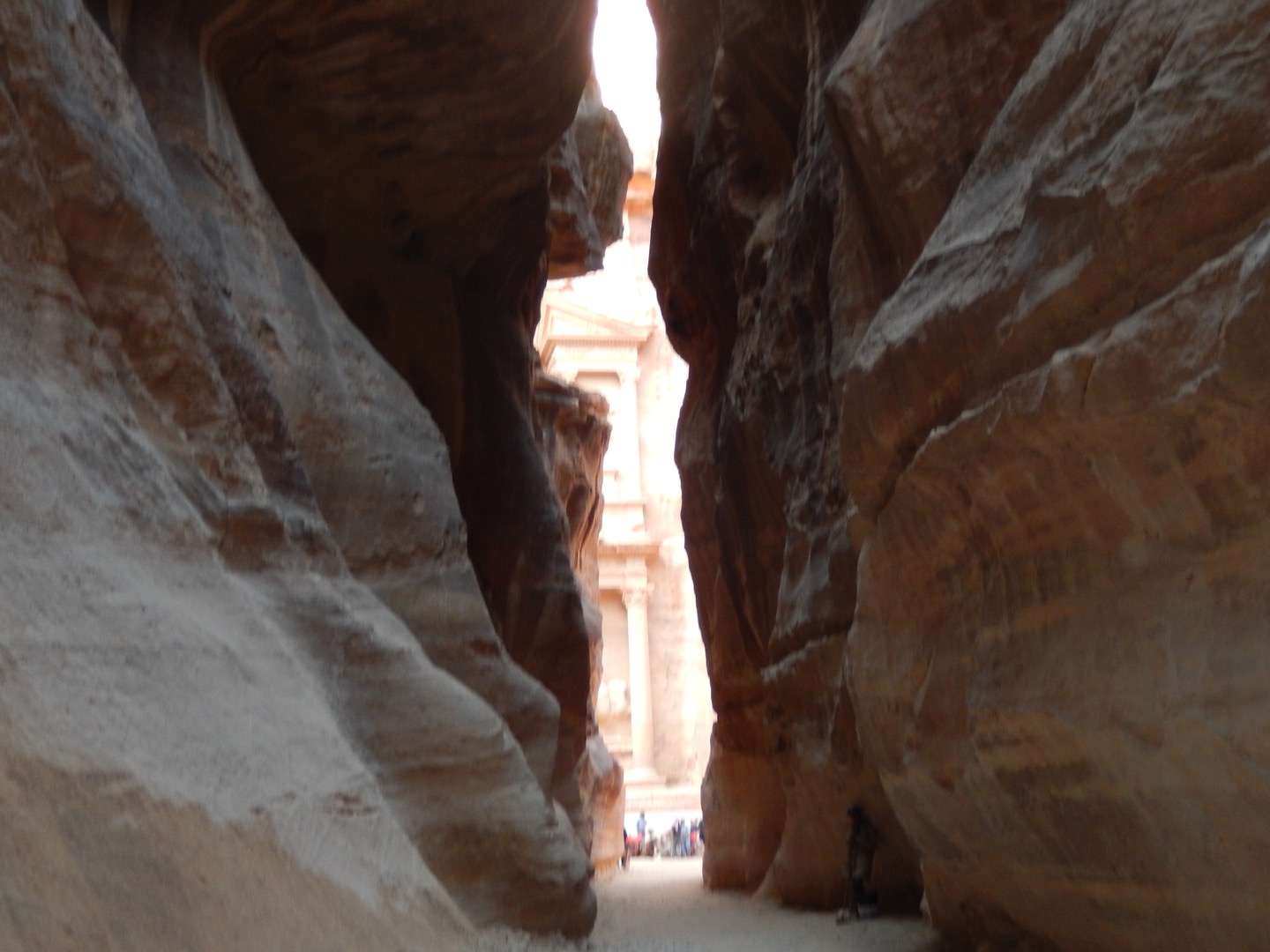
Things really get cool when you enter the Siq, a long (nearly a mile) tall (nearly 500 feet in places) imagenarrow gorge where you are cautioned to dodge the occasional horse carts that have no rules regarding pedestrians.image

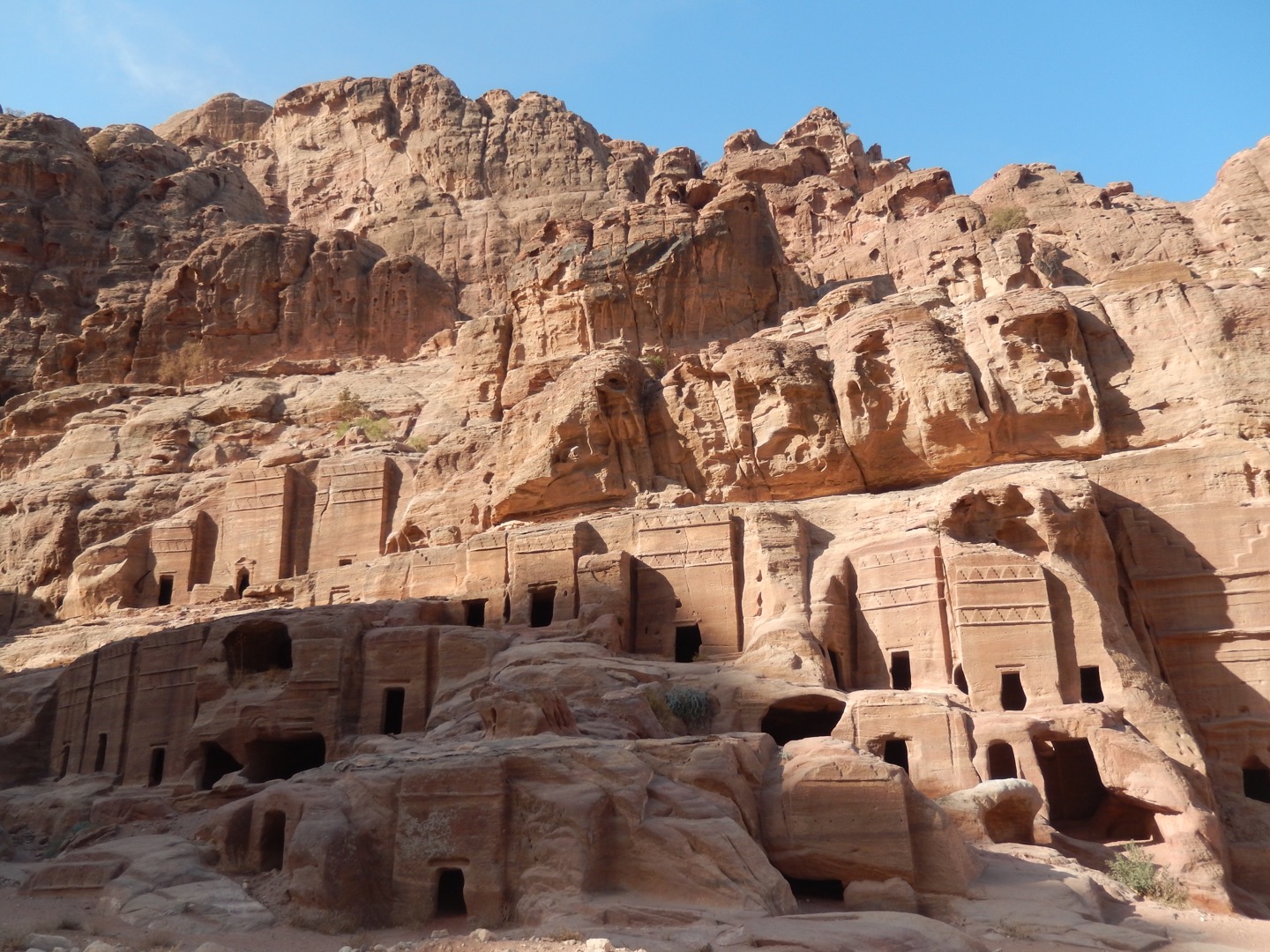
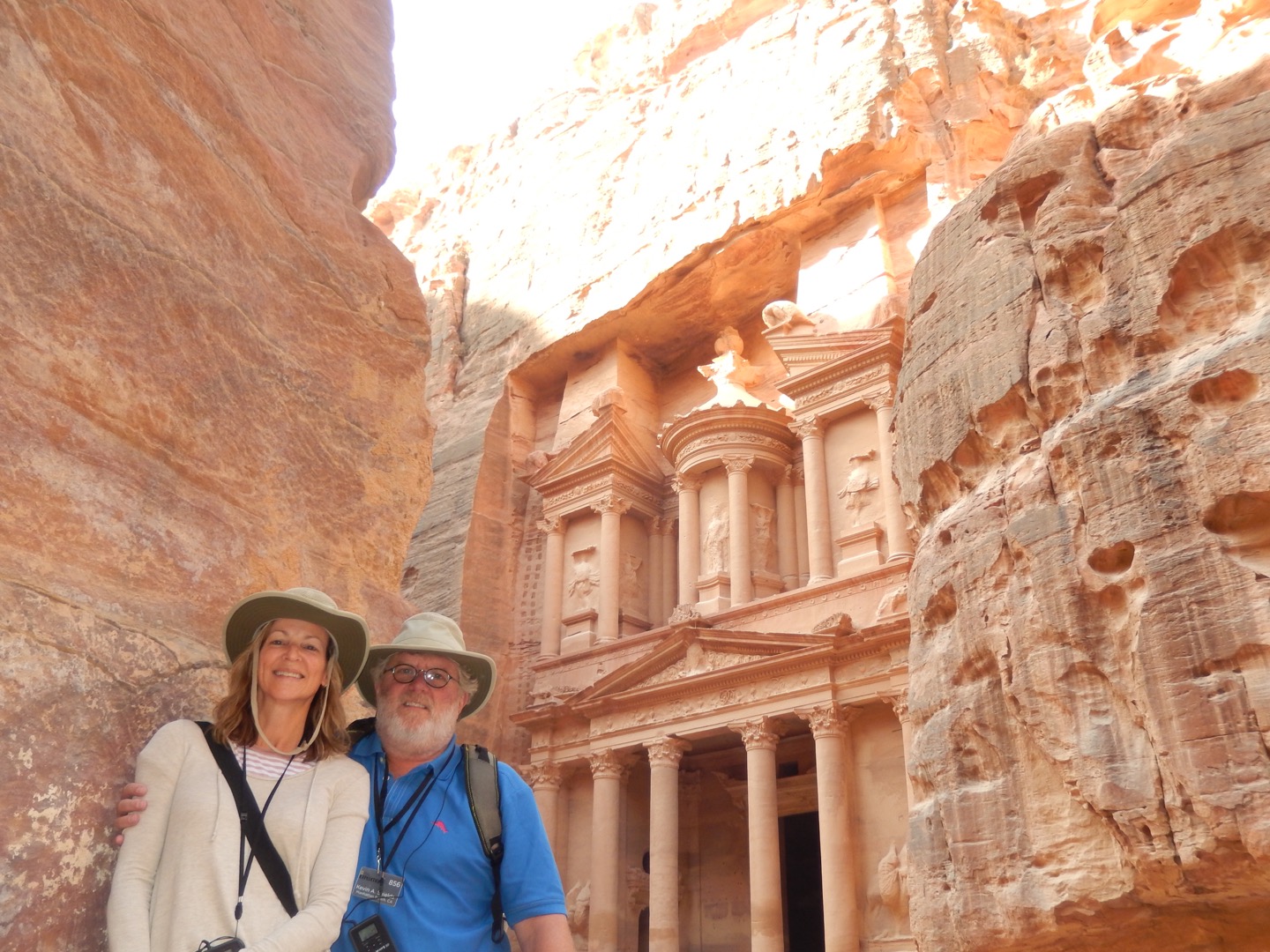
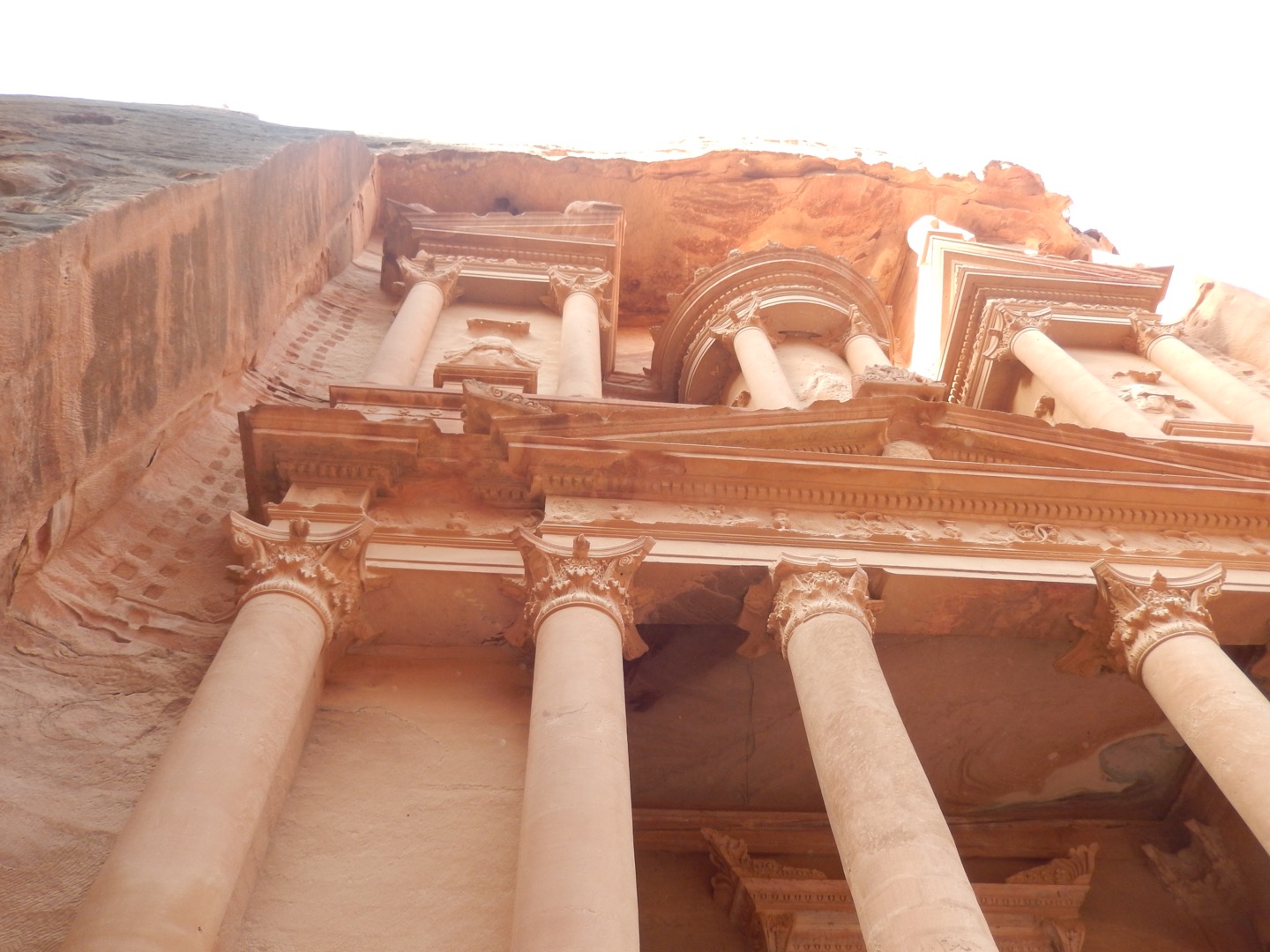
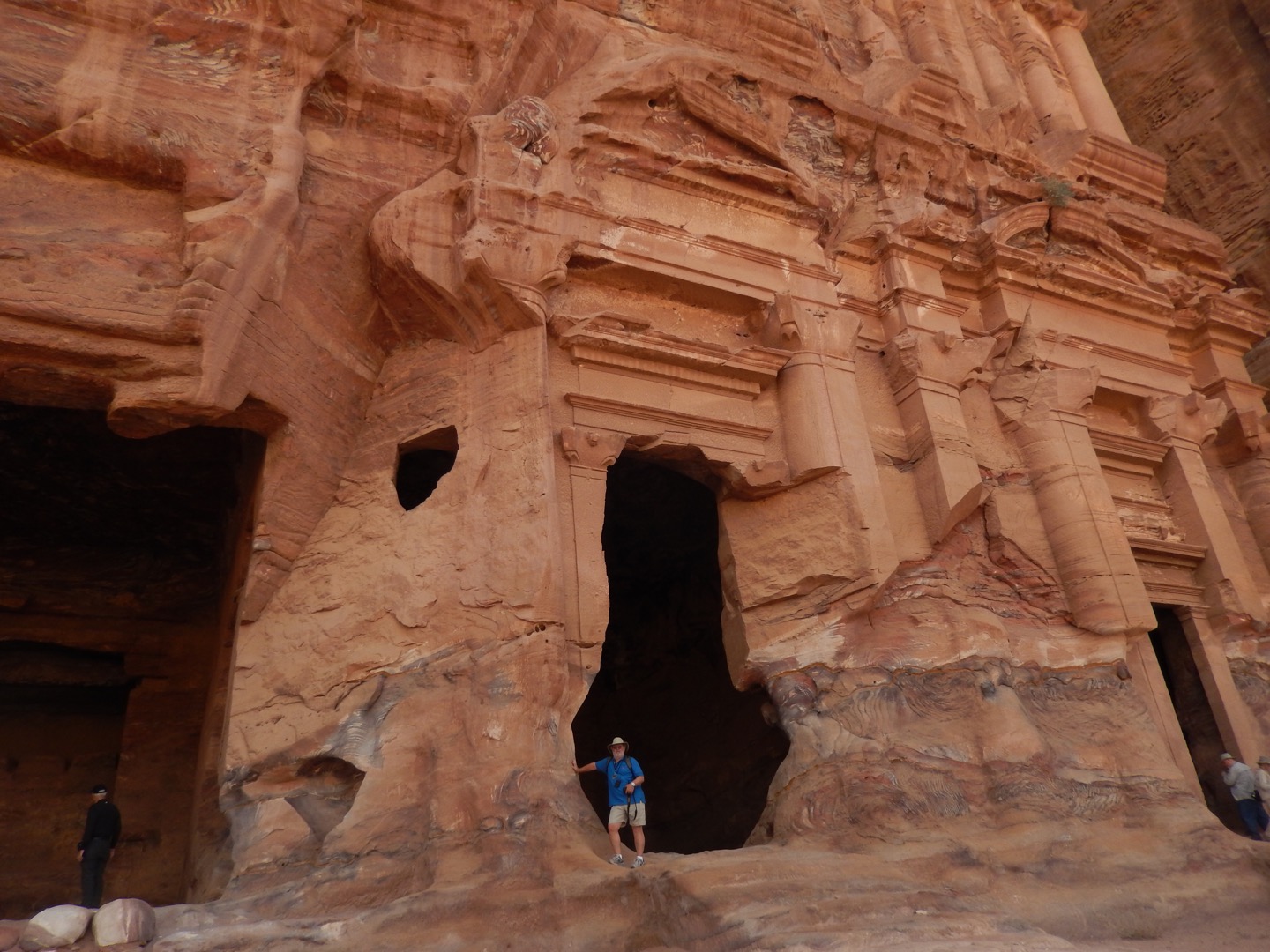
At the far end the Siq opens to reveal the Treasury. imageThis is the iconic structure of Petra from Indiana Jones. It looks like the exterior of a bank, more or less, except that it is a couple thousand years old and carved into the Rock. All of the ancient structures (BC) we will see in Petra are carved into the Rock like a cave as opposed to the newer structures (AD) which may be built of quarried brick or rock. image image
From there our guide, Muhanned (yes, he spelled in with a n) took us through the major sites of Petra. He is young and funny and likable. He pokes fun at the Saudis and at fundamentalists. His brother moved to America and married an American. Jordanians in general are liberal, not a surprise given that of the previous King’s 4 wives (in succession not simultaneous) one was American, and one, the mother of the current King, whose portrait, Kevin points out, looks a lot like John Elway, was a Brit.
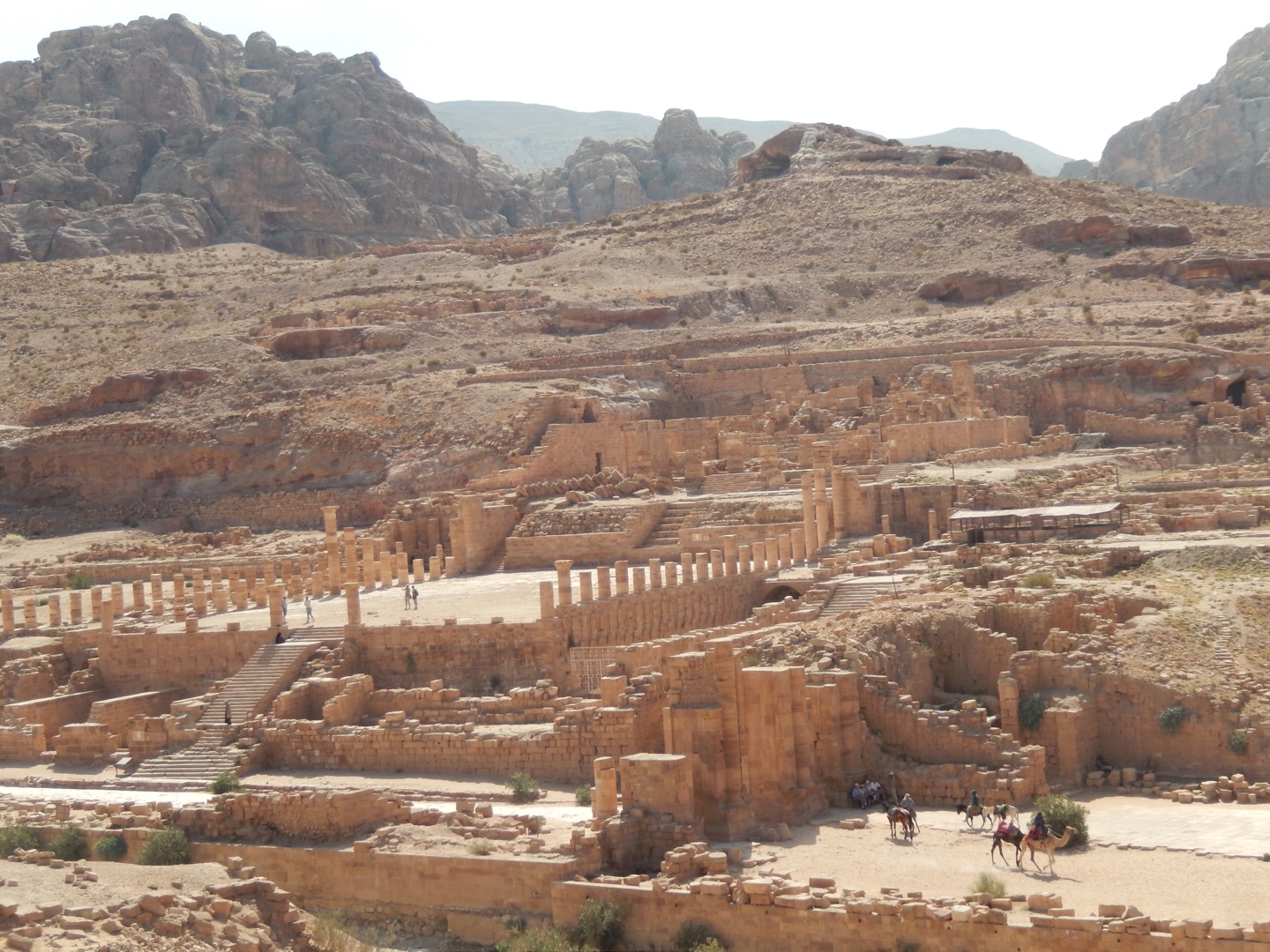
There are ruins of a couple of civilizations inside the mountain walls. Temples of the Nabatean people,image  imageand churches built by the Romans who conquered them (by cutting off their water supply).imageThe ancient city has a series of fairly sophisticated aqueducts. If these ran dry, you can see how the Nabateans would be forced out pretty quick (sneaky Romans).image
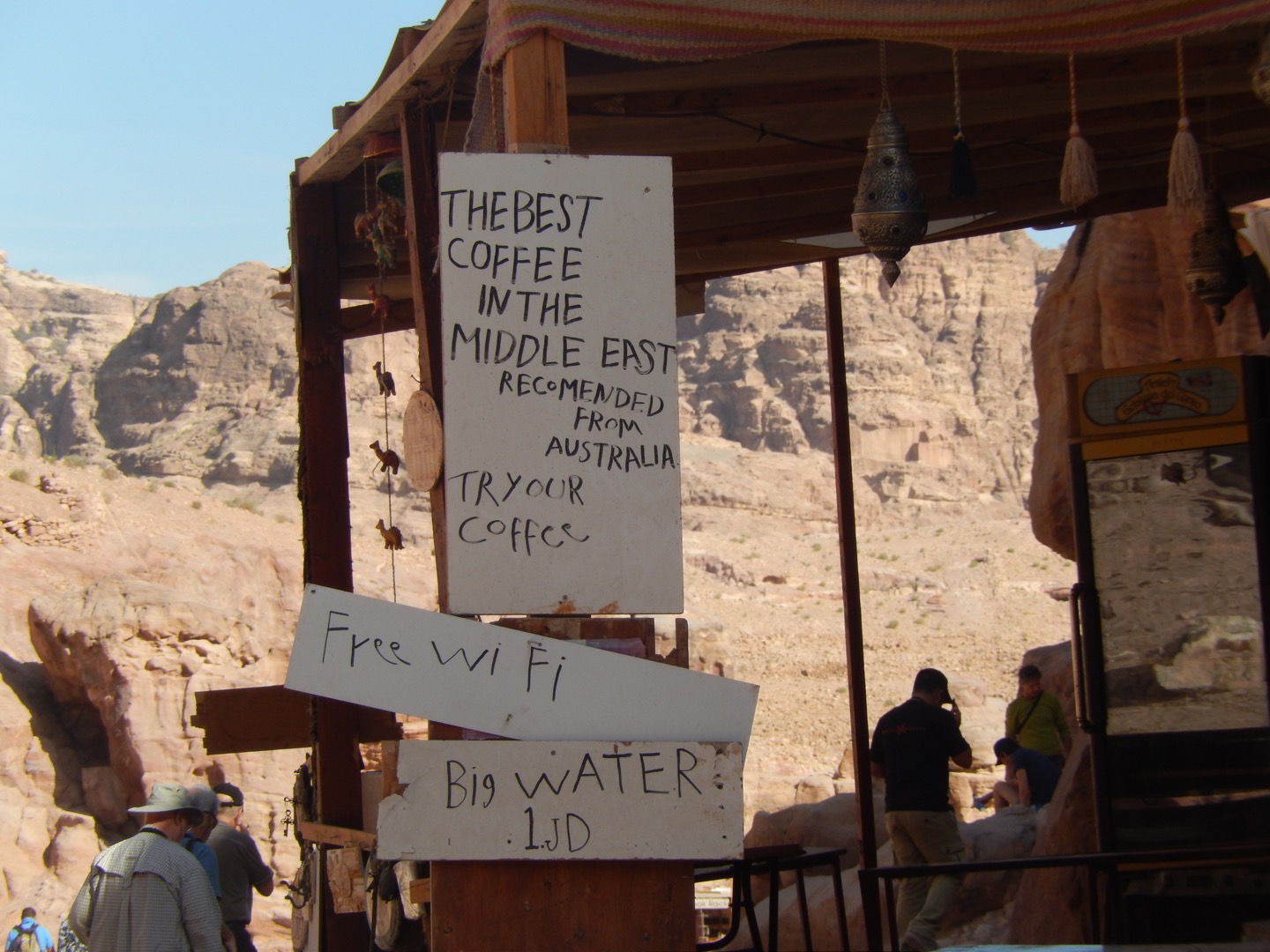
There are hundreds of vendors, though Muhanned does a decent job keeping them at bay. One little kiosk is operated by the son of the Western woman who married a Bedouin and lived with him in a cave for years. He sells signed copies of her memoir and a pretty collection of jewelry she designed based on Nabatean motifs. imageWe buy both.
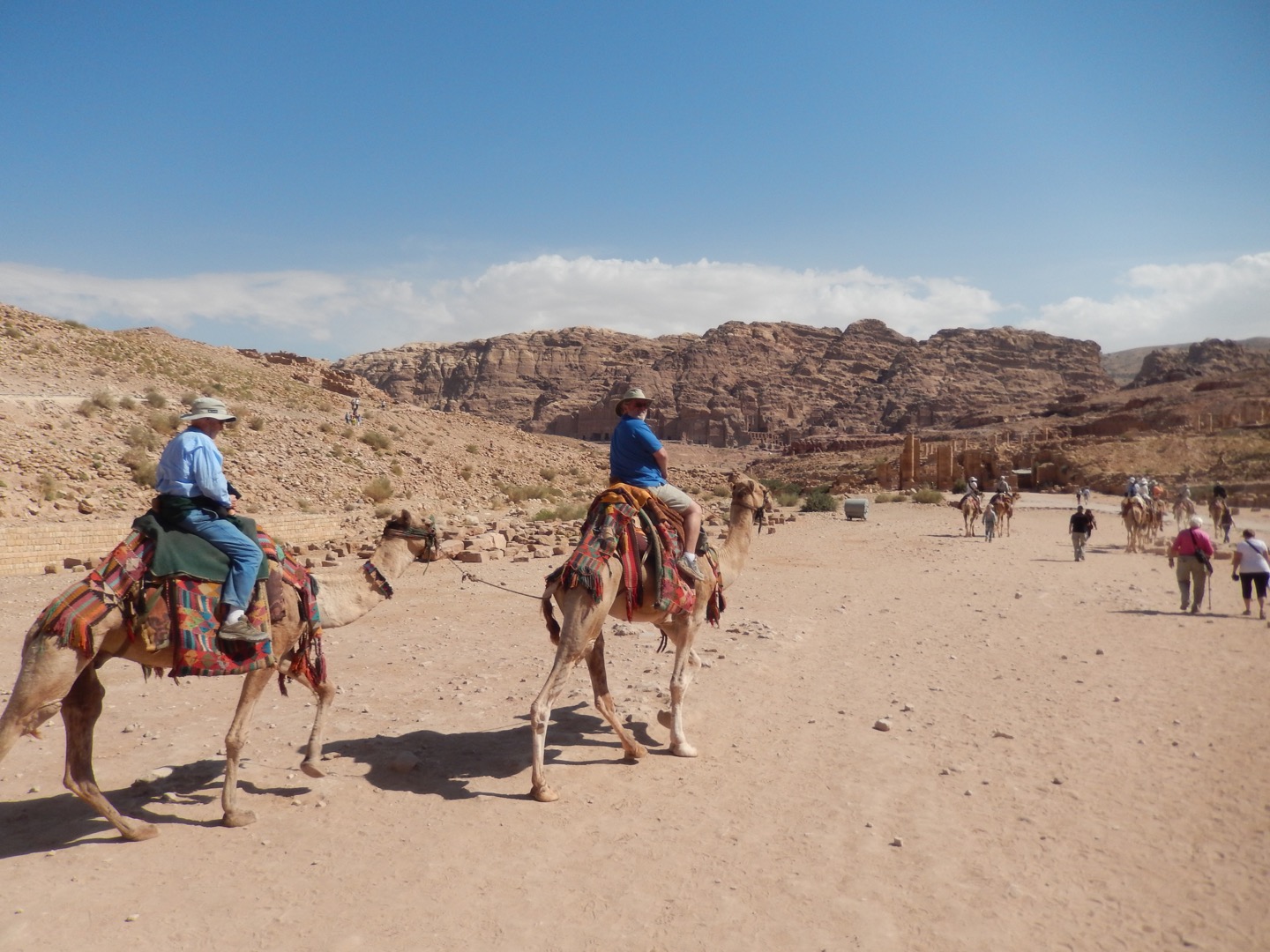
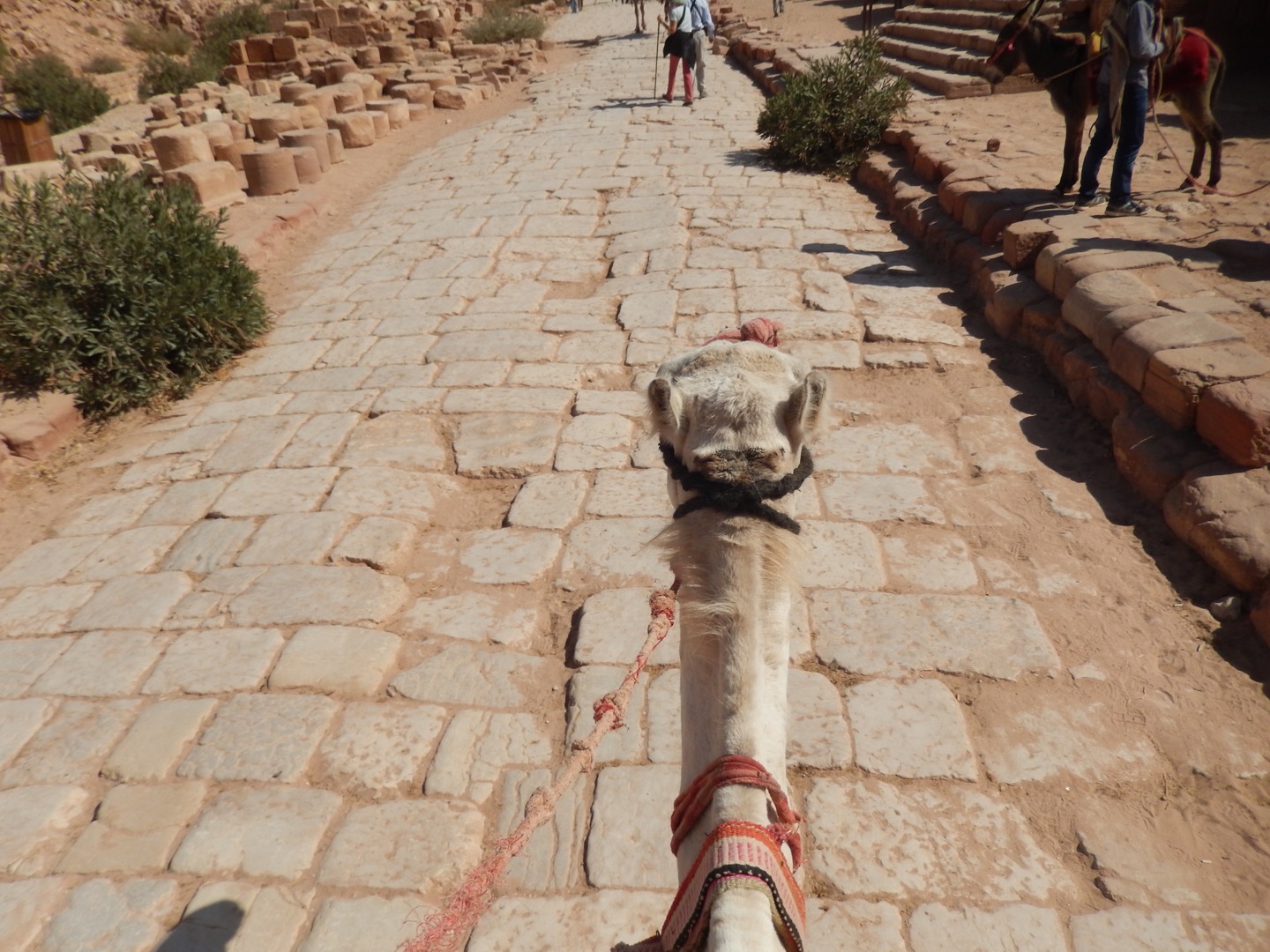
The tour ends at a restaurant which serves a big, middle eastern buffet (I eat rice, and rice and a couple samosas that I couldn’t resist). The walk in was nearly 3 miles, and after lunch the sun is blistering, so we opt to ride camels imageback as far as the Treasury, and walk that last mile through the shady Siq to the hotel, imagerewarding ourselves at the fabulous ice cream shop on the ground floor.
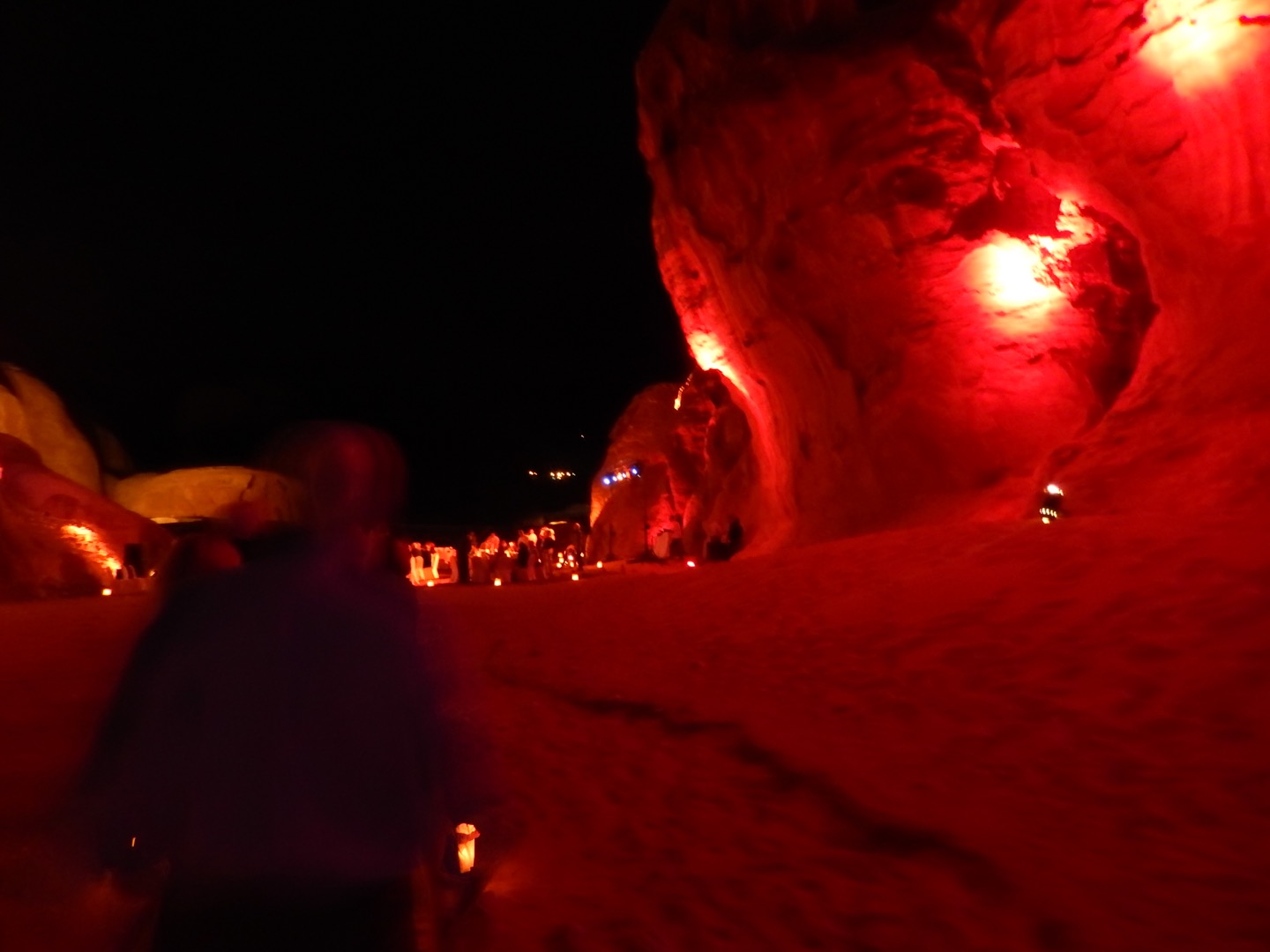
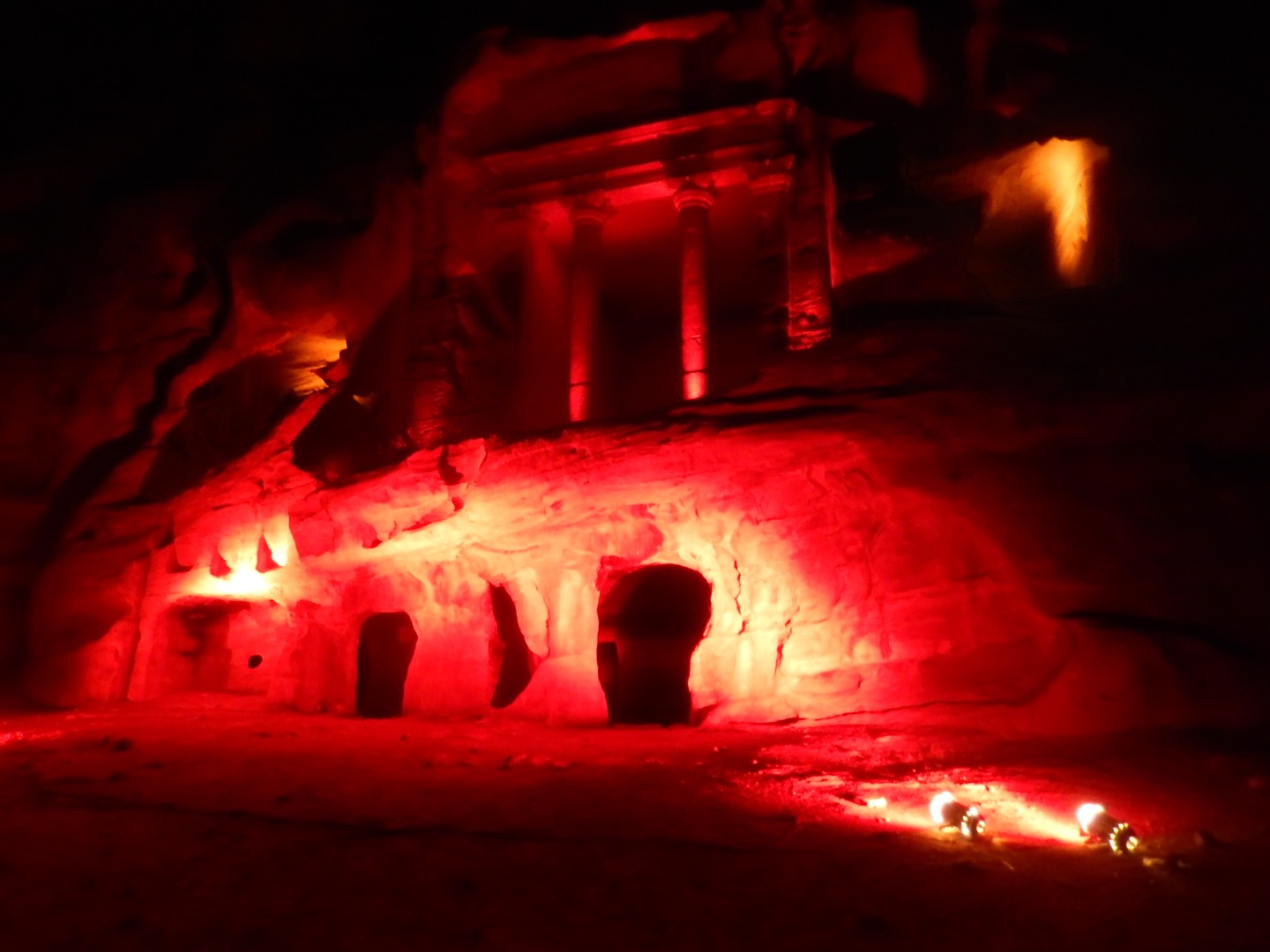
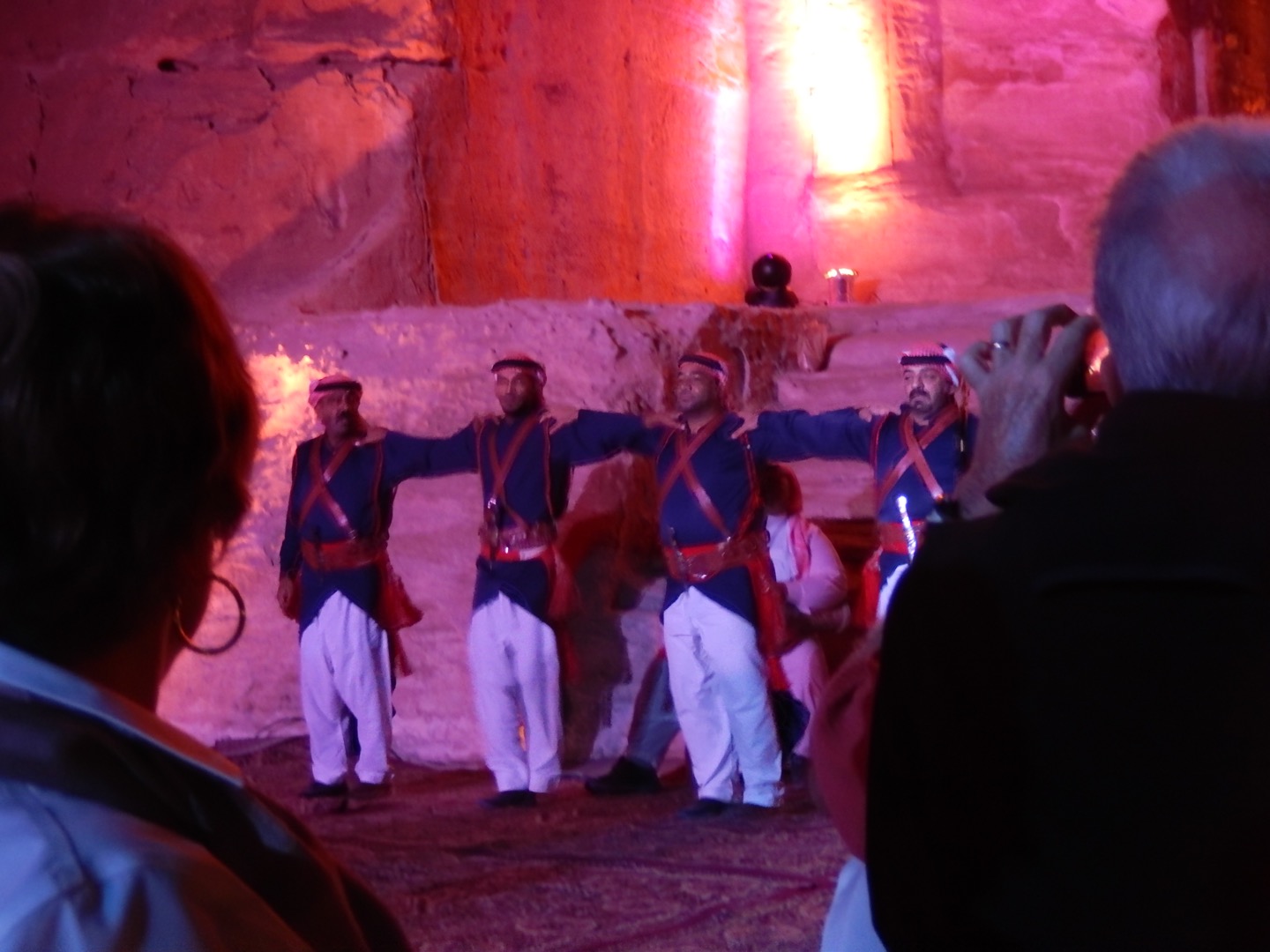
That evening we are bussed to little Petra. The Siq there, barely visible in the dark, has been laid with carpet runners and lit with thousands of candles set in paper bags full of sand. We walk it, single file. The sky so full of stars you can see the smear of the Milky Way. imageThe path ends at a clearing where cocktail tables have been set up, and then this crazy booming spooky Gregorian chant style music, like something from the exorcist or the omen starts and this wild light show from inside the little Petra stone monument. imageWhen we are led back out the entrance, invisible in the dark when we’d arrived, it has magically been lit up,image and filled with tables, where we are served a Bedouin feast with music and dance.image

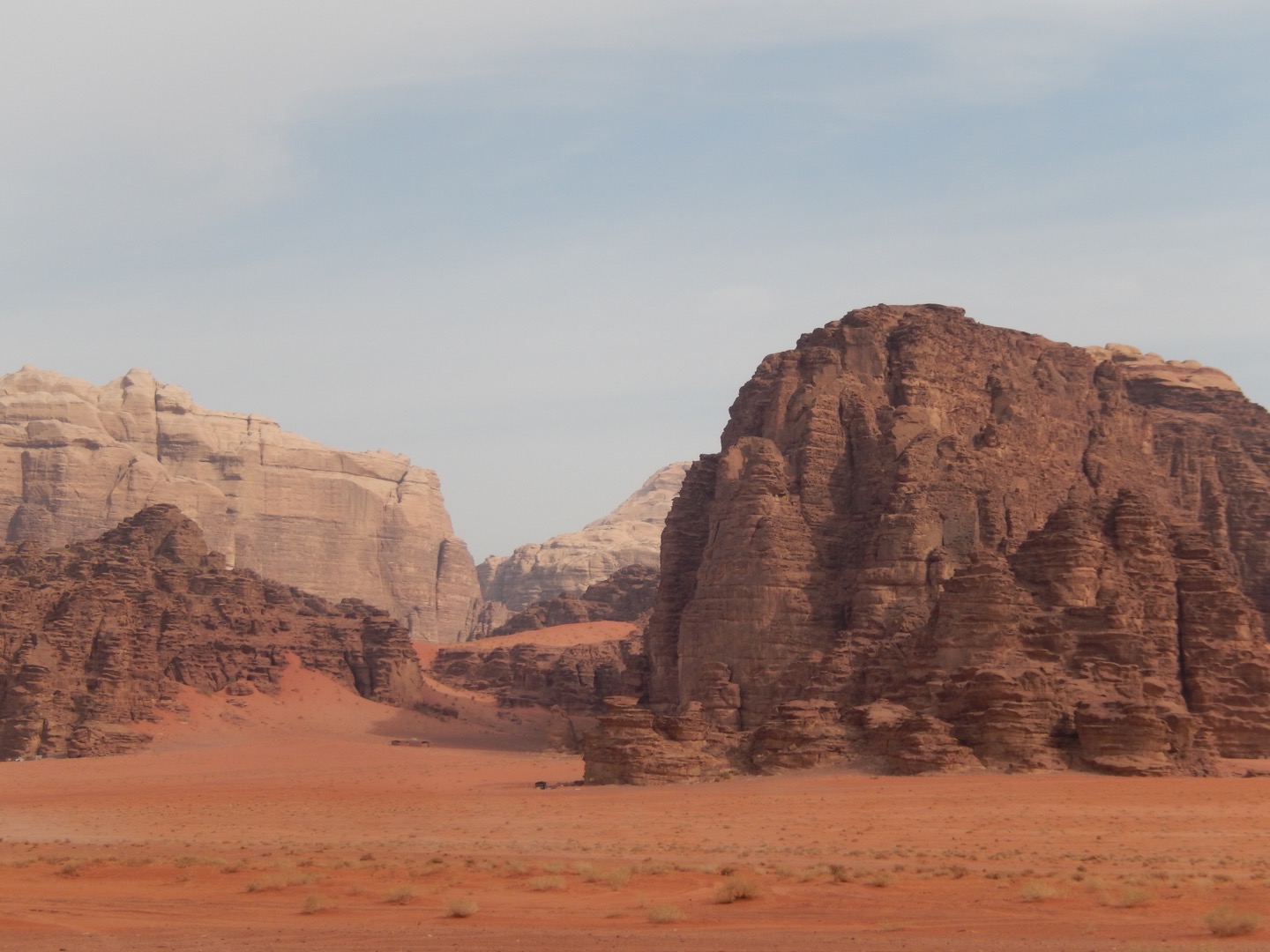
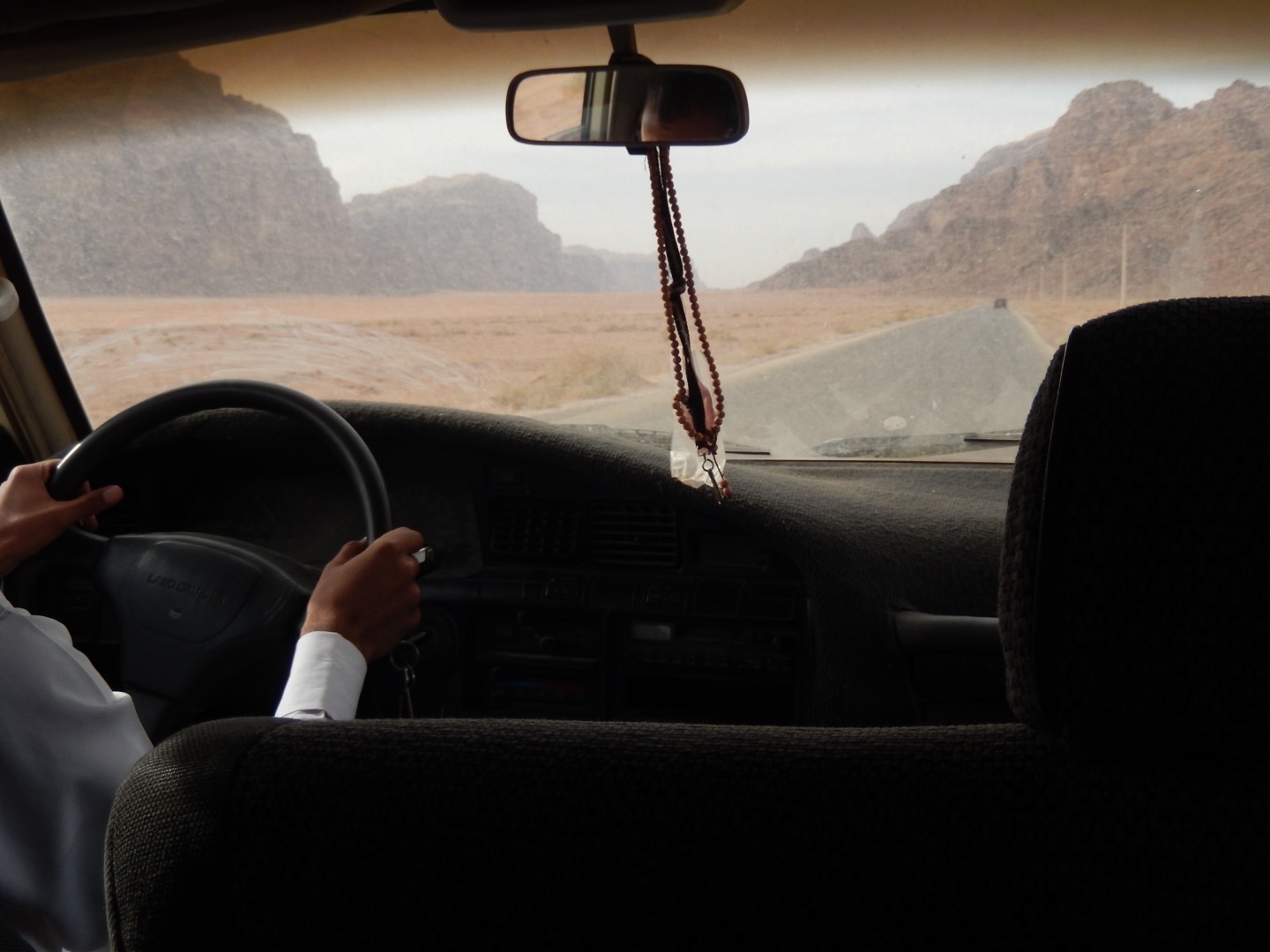
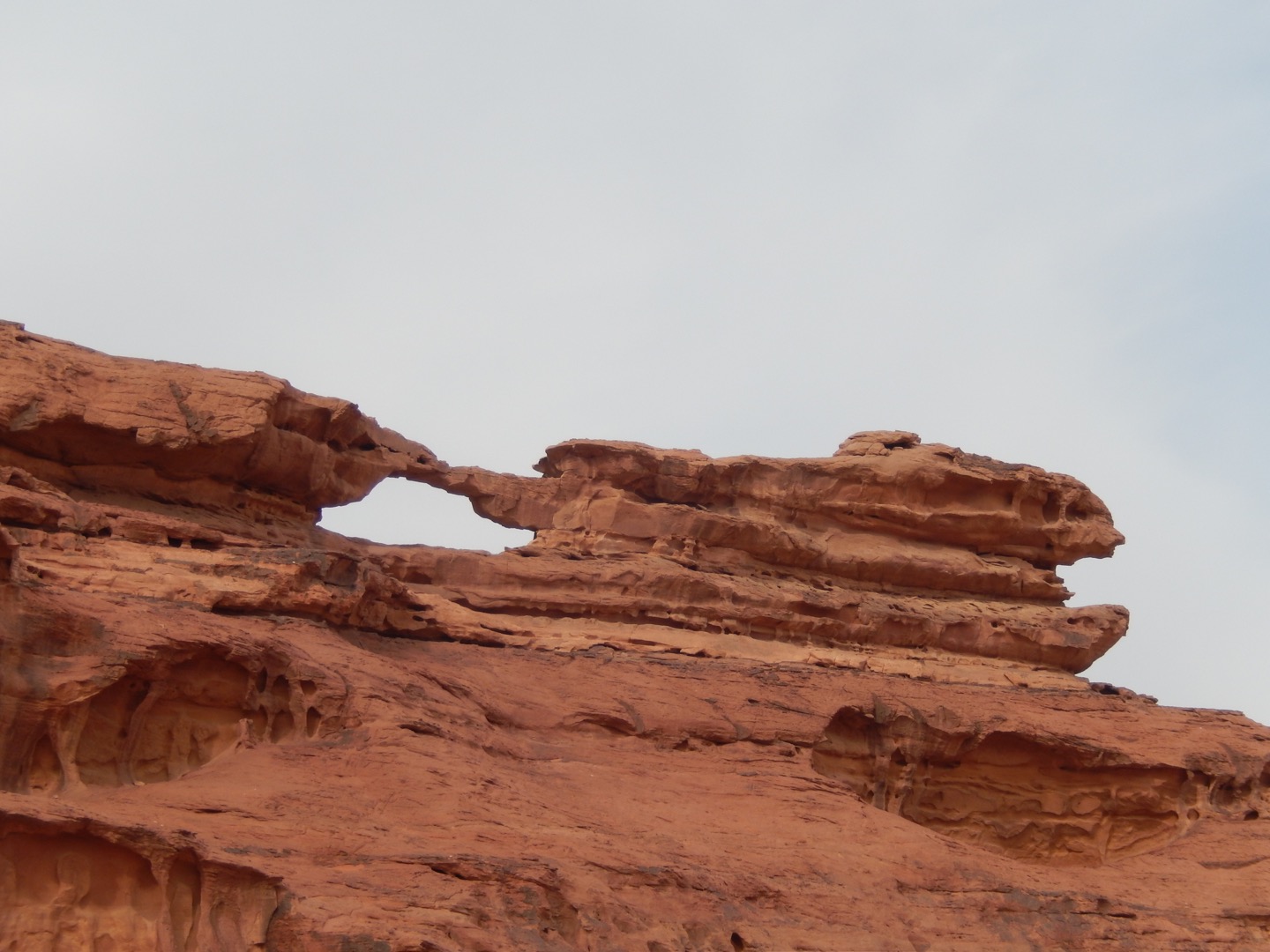
The next morning we visit Wadi Rum on our way back to the airport. Wadi Rum means ‘valley of the moon,’ and is reminiscent of monument valley in Utah.image Like a national park, there are just a few homes near the entrance where park workers live, and the rest in protected land for camping and recreation…like 4 wheeling. We are piled in pairs into 4×4 jeeps. Our driver is a kid, and it doesn’t take much encouragement from me to get him to really open that baby up imageand we blow by our more tentative companions, fish tailing and spitting sand. This land is where Lawrence of Arabia was famously shot, and also where the actual Lawrence past many times during the Arab revolt. He called this place the seven pillars of wisdom, and wrote a book about it. It is also where the current blockbuster ‘The Martian’ was filmed, as it is red and rocky and a great stand in for that rocky, dusty, red planet.image
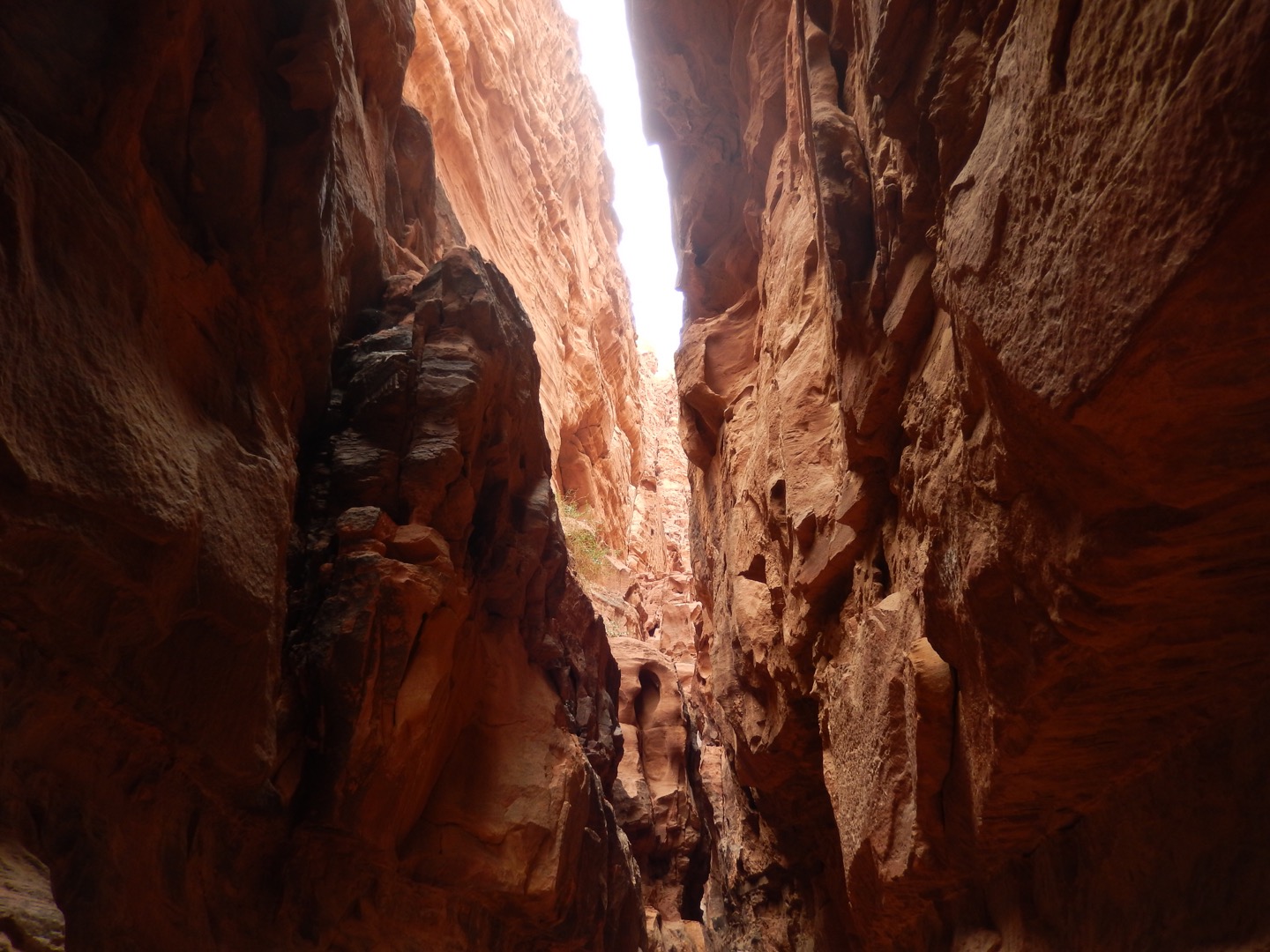
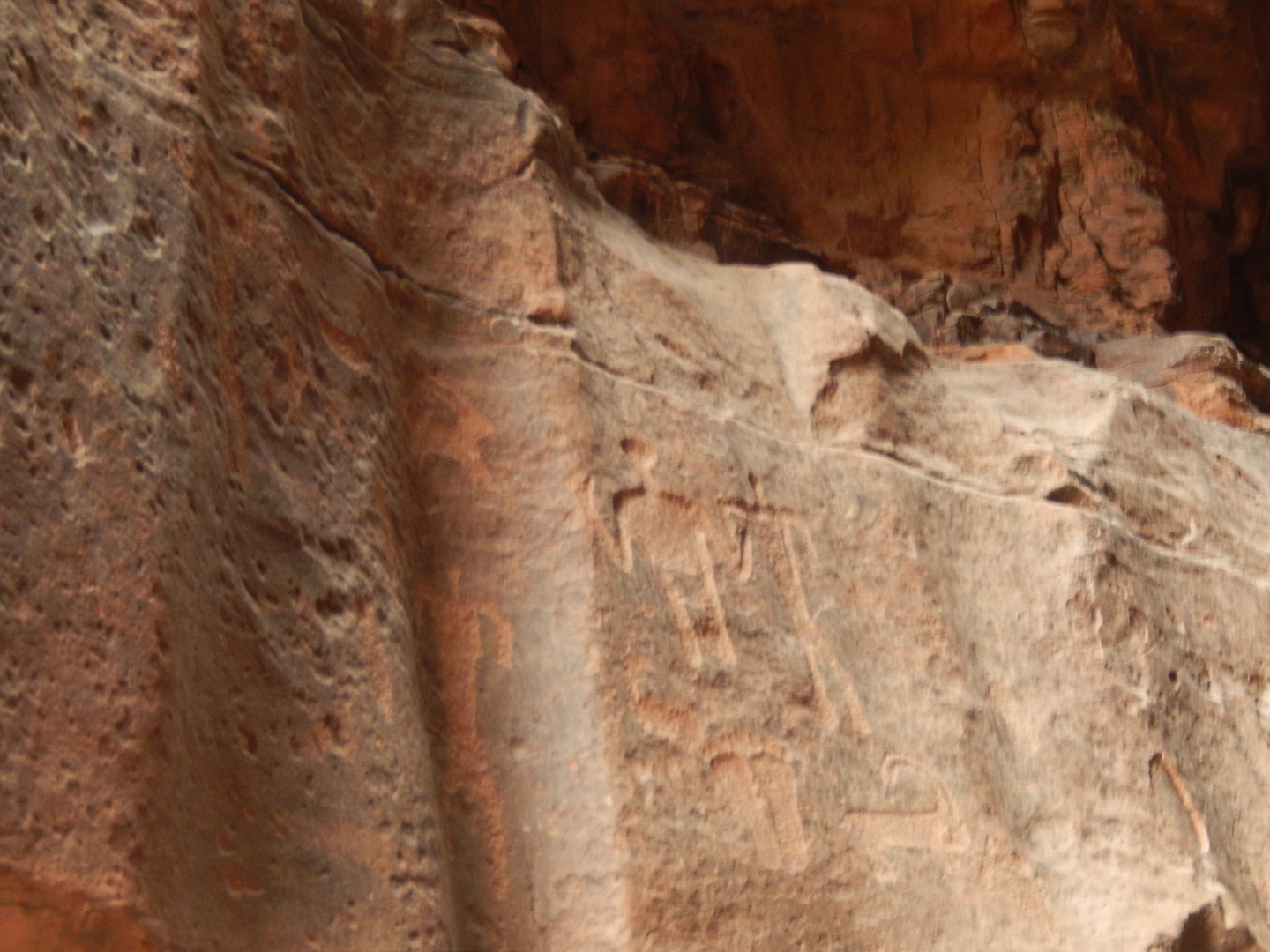
There are more remains of the Nabateans here, we enter Khazali canyon imageand admire their wall art.image (Which I must admit, I thought looked suspiciously ginned up for tourists).
After visiting a Bedouin tent for tea and biscuits, we head back to Aqaba airport and onward to our final destination-Morocco.