St Petersburg was the capital of Russia for a while back in the days of the emperors, but when that all went to hell in a revolutionary hand-basket it was renamed Leningrad and poorly neglected. And then it was occupied by Nazis.
Over the last 25 years or so since perestroika, they’ve spiffed it up, restoring all the grand palaces and homes of the wealthy and elite (who long ago were slaughtered or sent to Siberia) and it is a beautiful, bustling very European city once more.
Much like the stories of the kings and queens of England, the stories of the Tsars dating all the way back to Peter the Great are steeped in blood. Fathers killing sons, sons killing fathers, wives killing husbands, husbands banishing wives, peasants rising up and slaughtering the lot of them, it’s pretty grim (and entertaining) stuff.
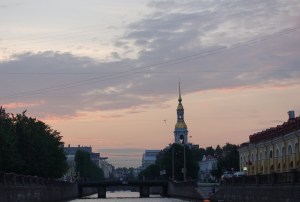
Like Venice, it is a city of rivers and canals and pretty bridges and embankments lined with buildings in colorful pastels. There are large public squares and archways and cathedrals. Statues of men, most of whom were murdered in some grisly fashion or another.


Our first day we spent touring Catherine’s palace, named for both Catherine the first,
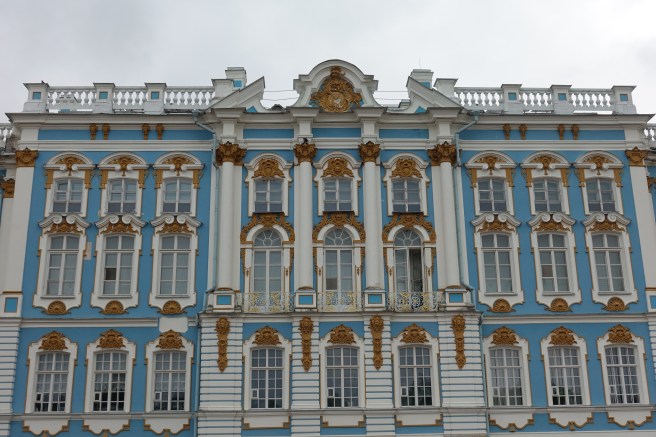 Peter the Great’s pretty German wife (whom he took after forcing his first wife into a monastery) and Catherine the Great, another German wife of a later emperor, who had her spouse killed and ruled happily alone for two decades and took several lovers.
That evening we dine at the Russian Vodka Room on caviar and vodka and Pate and dumplings and something called Salo which is thin rolls of salted lard on rye bread with spicy mustard and a scrape of garlic. We sit out on the terrace where it stays warm and light well past 10pm. We are promised a floor show with gypsies and a dancing bear, but leave before said bear arrives.
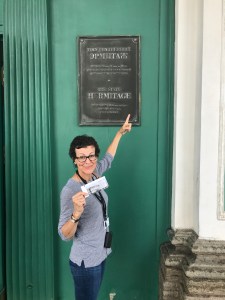
The next day we head to the Hermitage, founded in the mid 1700s by Catherine the Great and the second largest museum in the world. Beyond the extensive collection of art by such masters as Rembrandt and DiVinci, the buildings themselves are set up as a lavish multi room palace. We are lucky to be there on a Monday, when the museum (which generally gets over 20,000 visitors a day in summertime) is closed to the public. Not only is the place empty,


but we get a private view of the winding of the peacock clock – an amazing golden machine
– and we get to watch local art students who come in on Mondays to copy masterpieces as part of their schooling (always scaled larger or smaller than actual – to avoid possible counterfeiting)


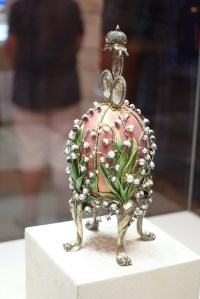
We lunch at restaurant Mansarda atop the gas building overlooking the St. Isaac’s Cathedral. Then head to the Faberge museum to see the infamous eggs, which were created as gifts from one of the slaughtered tzars for his slaughtered wife.
And then The Church of the Savior on spilled blood – which gets its name from (surprise!) the actual pavement upon which one of the other emperors was slaughtered. It is pretty astounding, full of amazing mosaics and packed with tourists.


That evening we take a river boat cruise on the Neva and its canals. The architecture of the buildings that line the river is gorgeous, huge rococo buildings in pastel mint and apricot and buttercup yellow – passing under several pretty bridges.
Our final full day in St Petersburg we take a hydrofoil across the river to Peterhof, the summer home or ‘dacha’ of Peter the Great built after he visited Versaille – from where he borrowed the ideas of formal gardens and several fountains, one of which goes off every house on the hour like it’s the Bellagio in Vegas and attracts throngs.


During WWII St Petersburg was occupied by Nazi troops, and here as well as in several other places we visit, years of painstaking restoration has been required to return the monuments to their pre war splendor.

After Peterhof, we take an afternoon to just wander the city and shop for gifts. The streets are very ‘grid like’ and it’s easy to navigate. Walking along the canal on the way home some petty crooks are nearly successful in picking my pocket (or purse in this instance) but I struggle to find my own keys in that thing, and they were defeated by its mess.
That evening we head to Yussupov Palace. Like all the other glorious palaces it was once owned by a noble family and was the location of a fabulous murder. (Or as said with proper Russian accent, more-deer) This was the place the last Tsar’s right hand guy, Rasputin, was killed. First poisoned with a cookie, the stabbed, then hog-tied and thrown in the river to make sure he was really, most sincerely, dead.
Inside the palace, we are taken through several large, fancy chandeliered rooms to a jewel box of a theater where we watch a sweet ballet performance.
Then in the ballroom we dine and listen to opera.
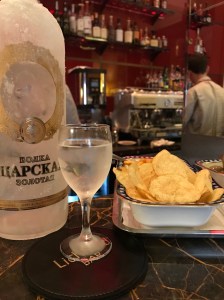
Then back to the hotel for our final night of ‘one and done’ beluga vodka in the bar.
Obviously you can’t travel to Russia without considering the politics. I came away with a better understanding about why the populace likes their Putin, because by and large they really do. Given the bloody and brutal history of the place, evidence of which is still physically and emotionally present in the lives of the people – they are accustomed to a certain level of corruption, oppression, control. They believe they are a difficult population to govern, that they require a president who is strong and strategic and a bit ruthless. That their experiments in true democracy were a failure. That losing a bit of civil liberty is an even trade for markets filled with food and buses that run on time.
 eileengoesroundtheworlddotcom