 Bhutan is a small mountainous country of fewer than 1 million dwarfed by its powerful neighbors, China and India, two aggressive suitors the Bhutan government simultaneously encourages and rebuffs in a delicate dance.
It has been called the last Shangri-la and is famous for something called ‘gross national happiness,’ which is the index used by the king to measure the success of his nation.
It is not simple to travel to Bhutan. The flight itself is a white knuckler for a nervous flyer like myself, a tiny airport nestled in a narrow valley that only a handful of pilots are qualified to fly into. Coming in, I swear I could see the birds in the trees.
Additionally, Bhutan does not allow you to backpack through. There are no hostels. They frown on ‘hippies’ (seriously, my guide used the word hippies). All travel must be negotiated through a certified agent and involve the expenditure of an average of $250. per day. They know they have something the public wants, and they are not going to let it go cheaply. The upside to this is the country is not overrun with tourists. I barely saw any.
The bus ride from the airport in Paro to the capital city of Thimphu takes about 90 minutes. There is only one road, 2 narrow lanes that wind around the mountain. We pass a lot of dump trucks (as construction is a constant – homes, roads, etc) each one decorated more spectacularly than the last.  The road is punctuated with silly signs about speeding and littering. These were erected by the Indian company who builds all the roads.
  Indians also do the construction of the homes. They are the cheap immigrant labor of Bhutan.
All of the Bhutanese people wear traditional dress during the daytime, the men’s looks like a plaid bathrobe and is called a gho, the women’s a long slim skirt called a kiro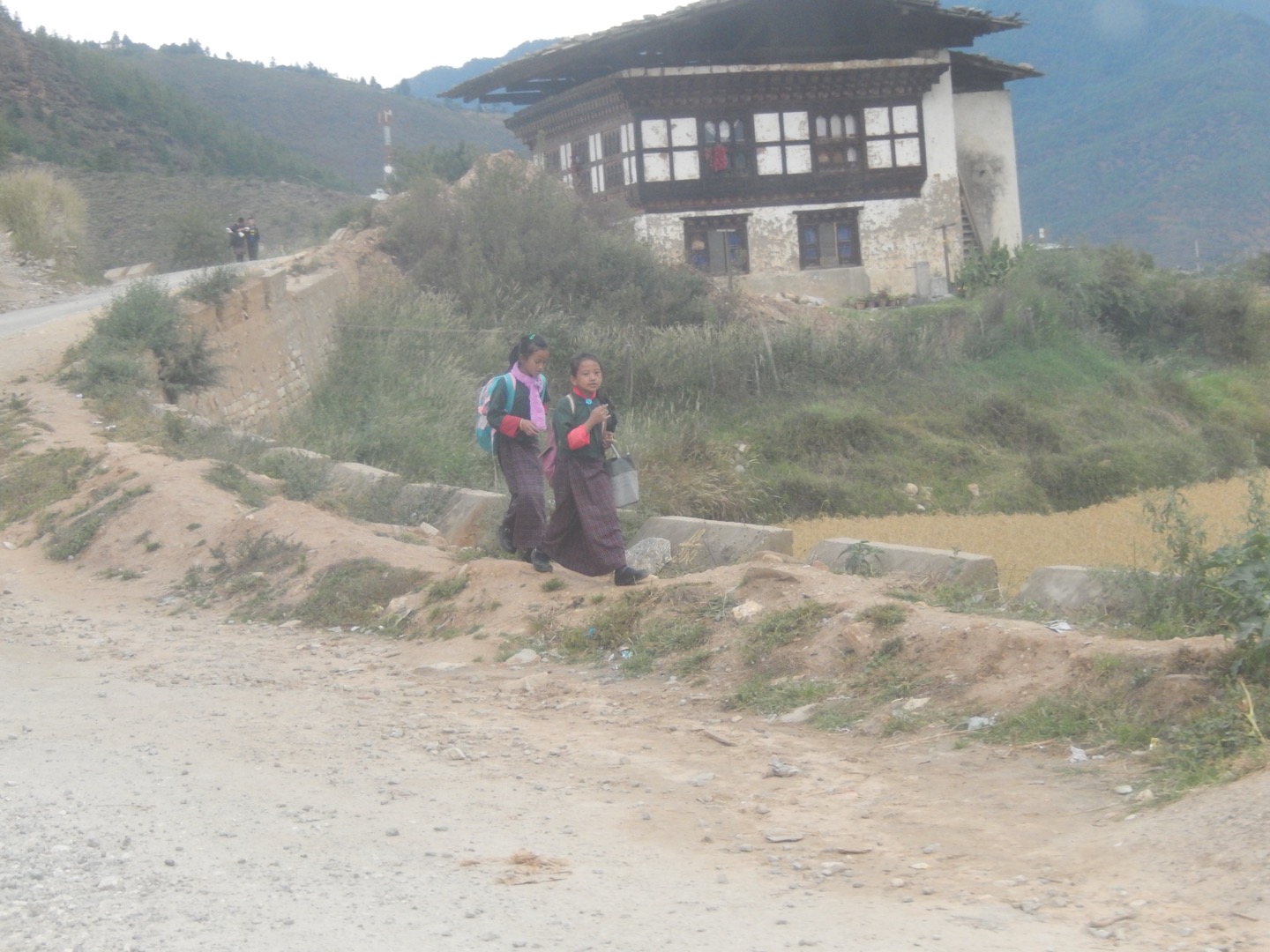
The people of Bhutan are all dark, small, and slender. Few of them own cars, and there are no motor scooters at all. These people walk everywhere in this mountainous region. Farming is the major industry, but the farms are tiered as there isn’t any level ground.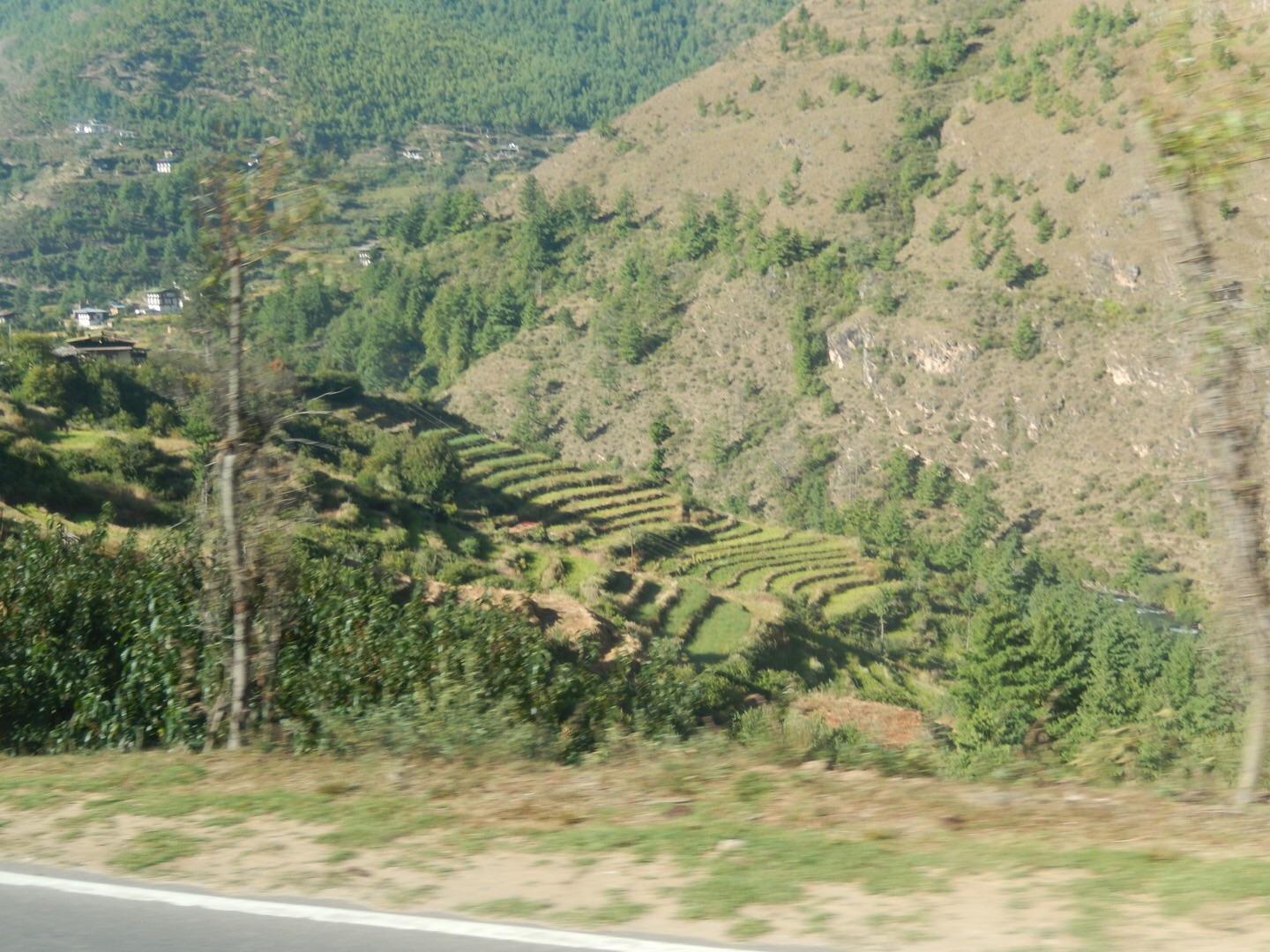
We stop at the Paro Ta Dzong on the way to the hotels. It’s a sort of medieval fortress perched on a hillside which operates as a Buddhist temple. After passing inspection (Kevin is wearing shorts, and is asked to cover his knees) and removing our shoes, we are ushered inside (no photos allowed inside the temples) where we witness three lines of ten monks each, kneeling and chanting and banging on these oddly suspended green drums in a room draped with mad, multi-colored fabrics, fuchsia and turquoise and orange and gold and thick with incense, it overwhelms the senses.
Because our trip was put together so quickly (in response to China pulling our landing permit) our group is split into 2 hotels. We are put with a small group at the Amankora, which is a gorgeous, spacious, zen like lodge in the mountains- not far from the homes of the royal family. The rooms are huge with the bed at one end and the shower and sinks at the other… in between is a bathtub, with a chair perched at one end, I suppose to better view the bather? The hotel restaurant is spectacular, particularly the pastries at breakfast. I ordered a Dutch baby one morning, ( a sort of fluffy but crispy pancake) and I am still thinking about it.
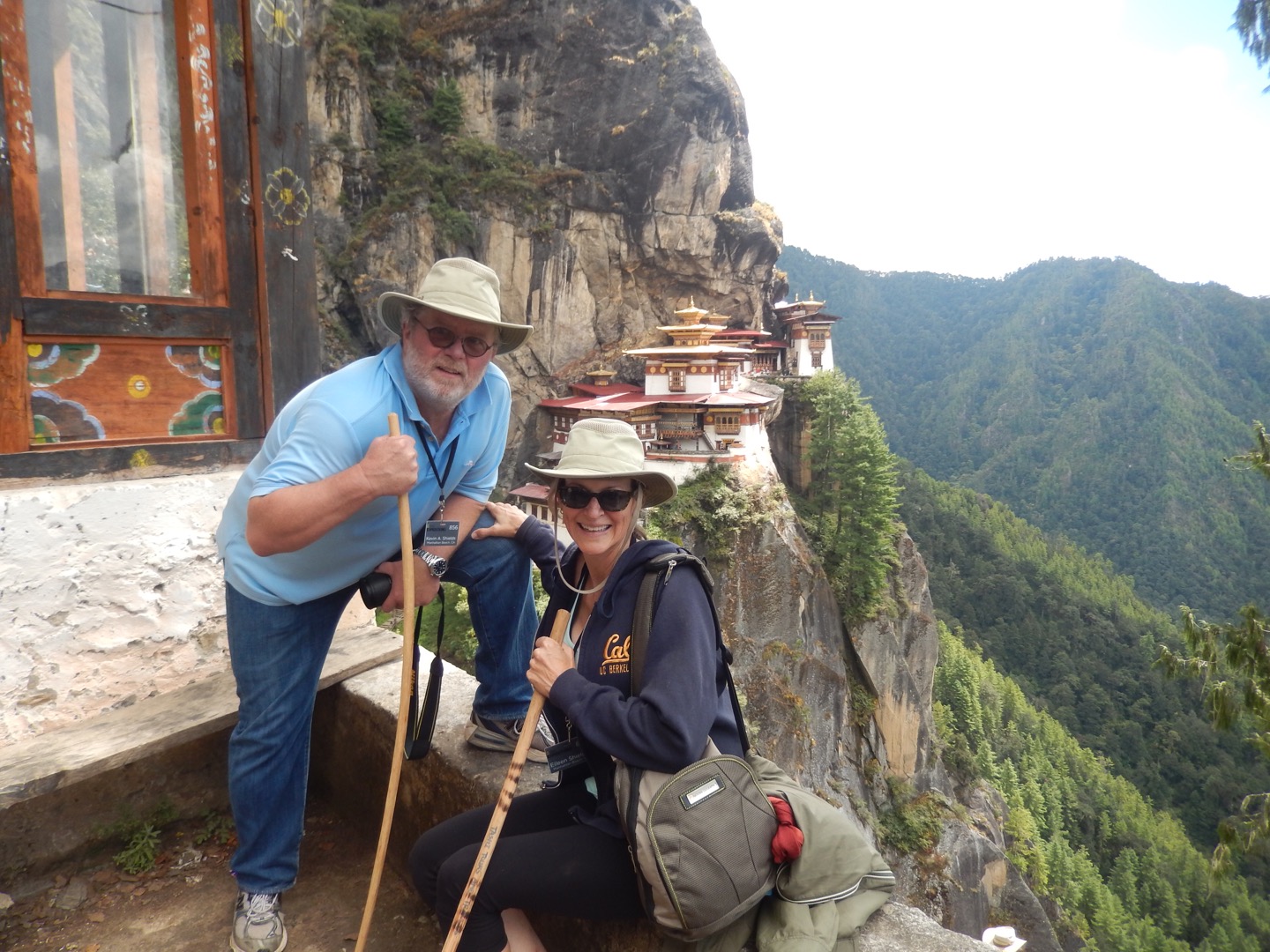
Our first full day we are up early to hike to the tiger’s nest, which if you have EVER seen a photo of Bhutan is probably what you saw. It is a series of buddhist temples illogically clinging to the side of a mountain.
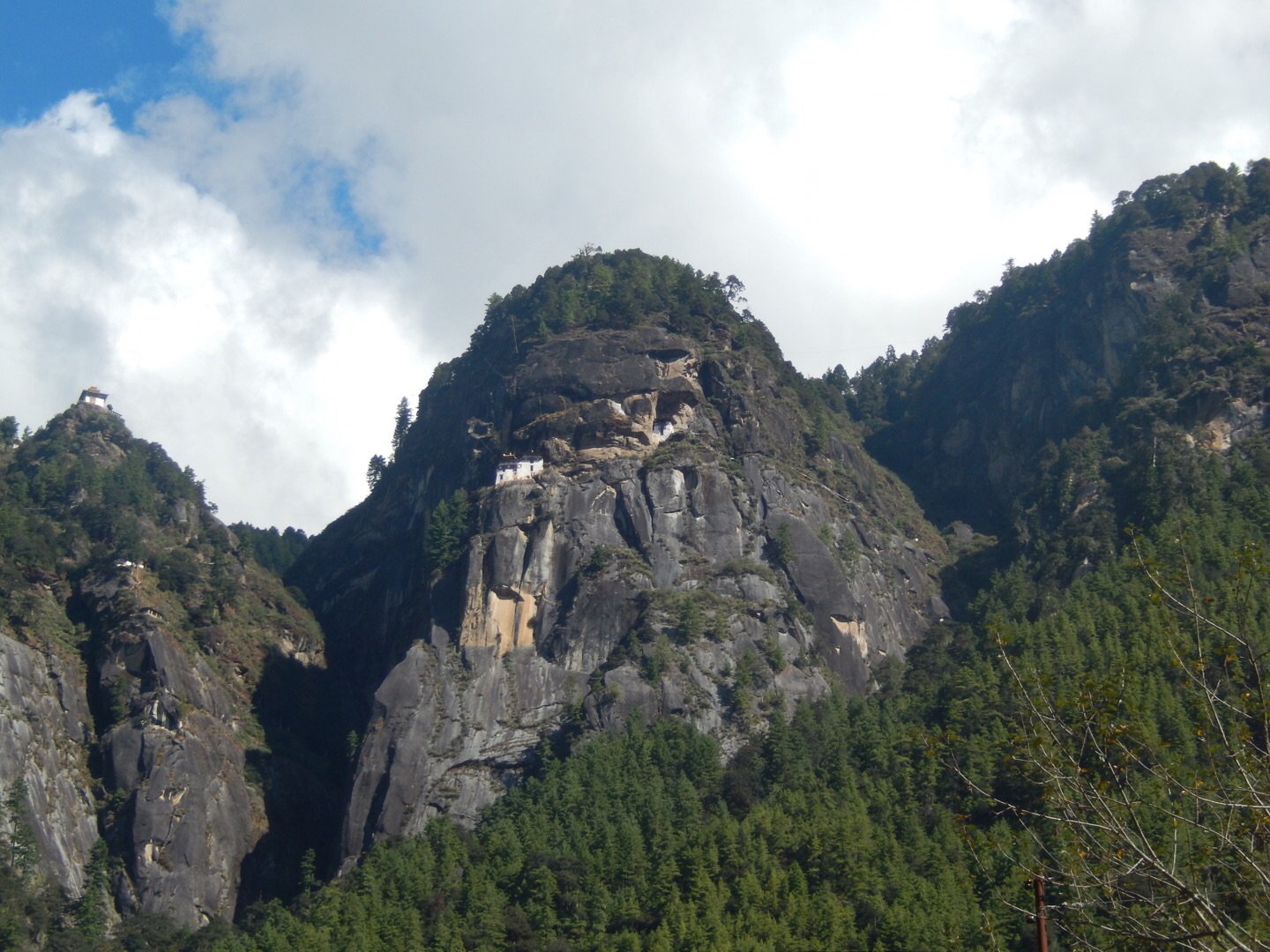
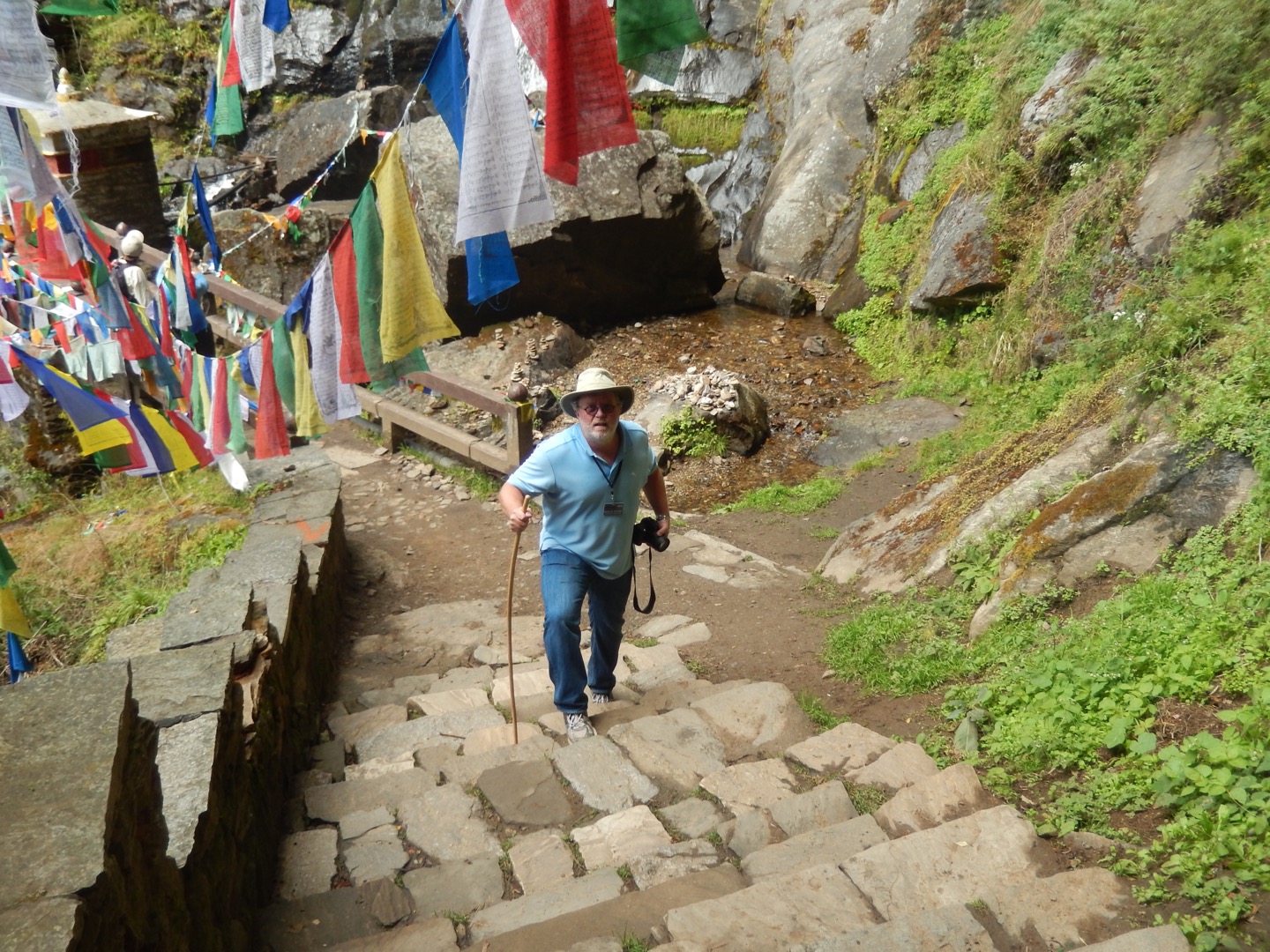
The hike is a challenging 5 hour round trip of about 1650 feet of elevation. Of the 70 people on our tour, 50 attempt it, but only around 20 complete it (this may make it sound more difficult than it was. Kev and I are of average fitness, but accustomed to hiking in altitude and younger than most of our fellow travelers) 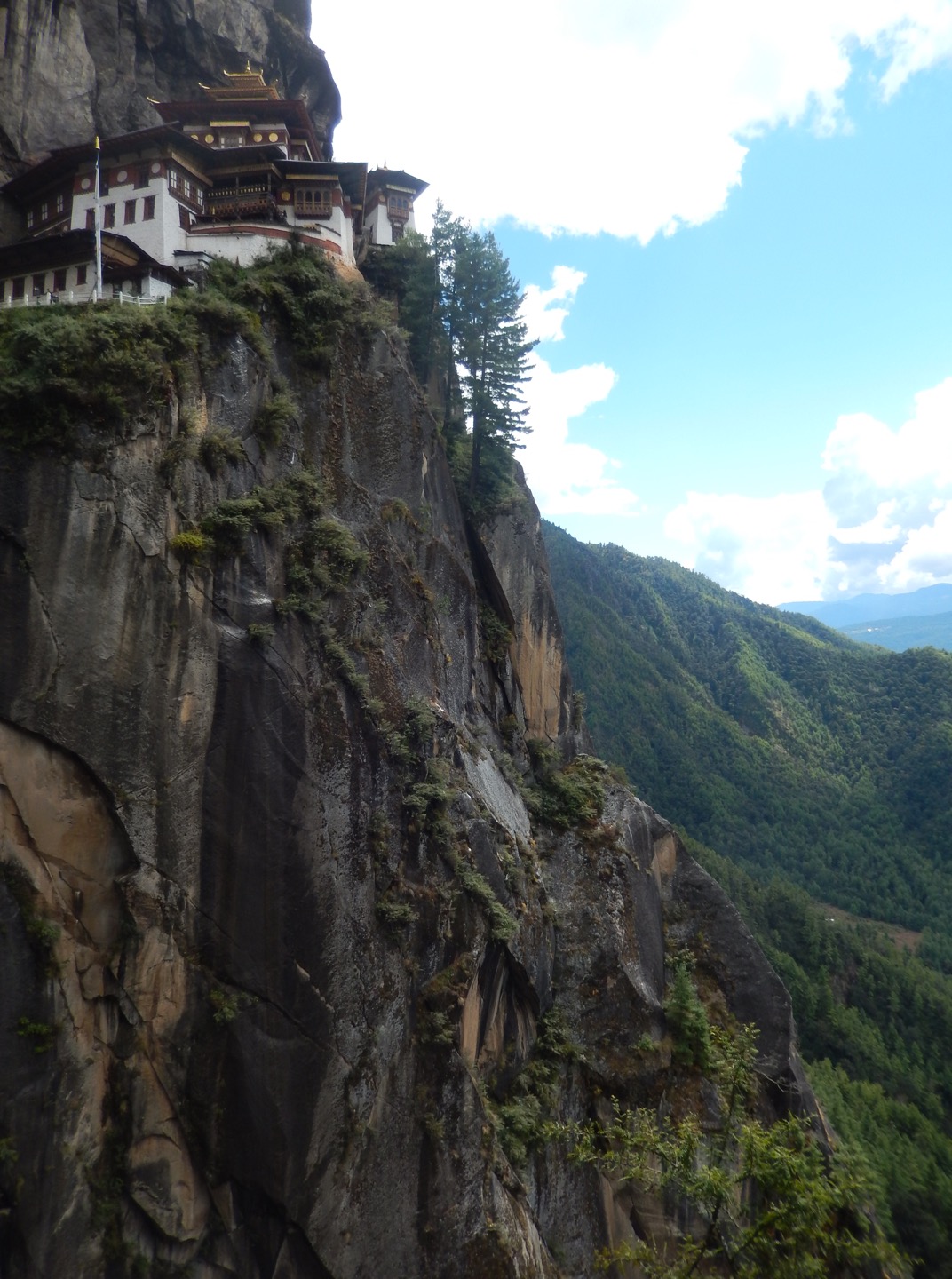 Halfway up there is a
 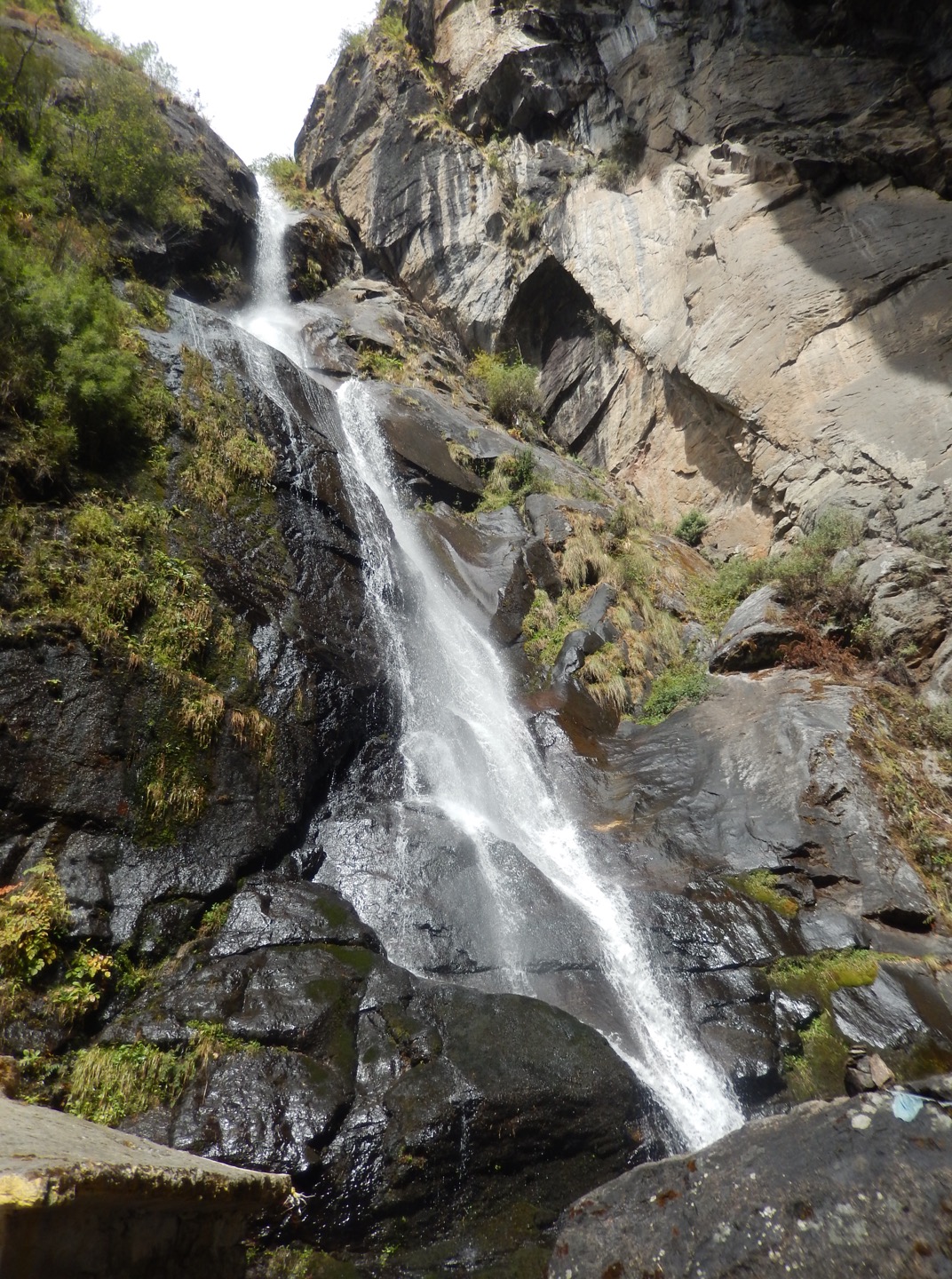 tea house where you can stop and rest and determine if you have had enough. Beyond that is a lookout point where everyone stops for the ‘iconic’ photo, and then there are a series of hundreds of steps the first descend into the gorge and then climb out of it.
  As you arrive at the temples, you must remove your shoes and leave your cameras and backpacks behind. Once within the arrangement of temples, the monks are friendly, inviting you to meditate, anointing you with saffron water, instructing you in the Buddhist ways. To become a ‘master’ in the Buddhist faith, these monks must complete a solitary meditation of 3 years, 3months, 3 weeks, 3 days…and they cannot see or listen or speak to another person during this time, or their meditation is broken, and they must begin again. There are a few small ‘meditation’ houses above the tiger’s nest, and the monks handle the feeding and protection of the monks inside.
We descend and stop at the tea house, where they have set up a typical Bhutanese buffet for us, the red rice they farm all over, baked scrambled eggs, and the national dish of emadatshi, made of spicy green chiles and cheese. The Bhutanese love chiles, and you see them drying on the roofs of the valley houses as you drive by.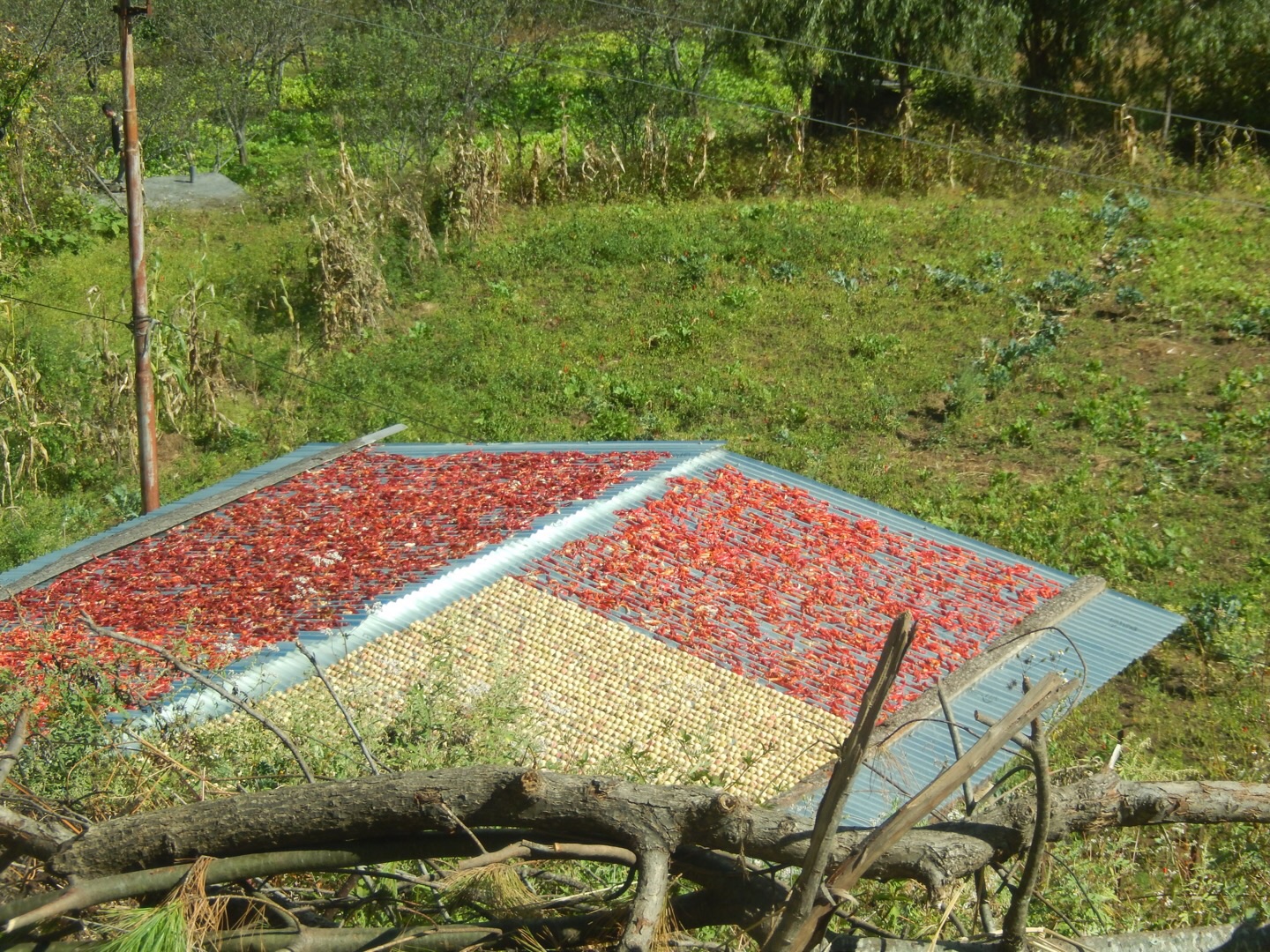
On the long bus ride back, we learn even more about the People. They are all Buddhist, but not necessarily vegetarian. But since part of their faith is protection of all animals, the meat must be imported from India (they cannot slaughter) which seems a pretty slippery slope to me.
Along the roadside, tucked into creases in the cliffside, you can find tiny stupas, or funerary monuments. These are made of the powdered skull of the departed (Buddhists cremate the dead) mixed with milk and whatever to make a sort of plaster offering roughly the size and shape of a macaroon cookie.  We saw some of these stupas in a cove next to a waterfall near the entrance to the tiger’s nest. If I drop dead on this trip, I would not mind if someone made a paste of my pulverized skull, baked it into a cookie, and left it there. It seems a romantic notion.
Ribbons of prayer flags festoon every hillside like a giant auto dealership until they are shredded to nothing by the wind. 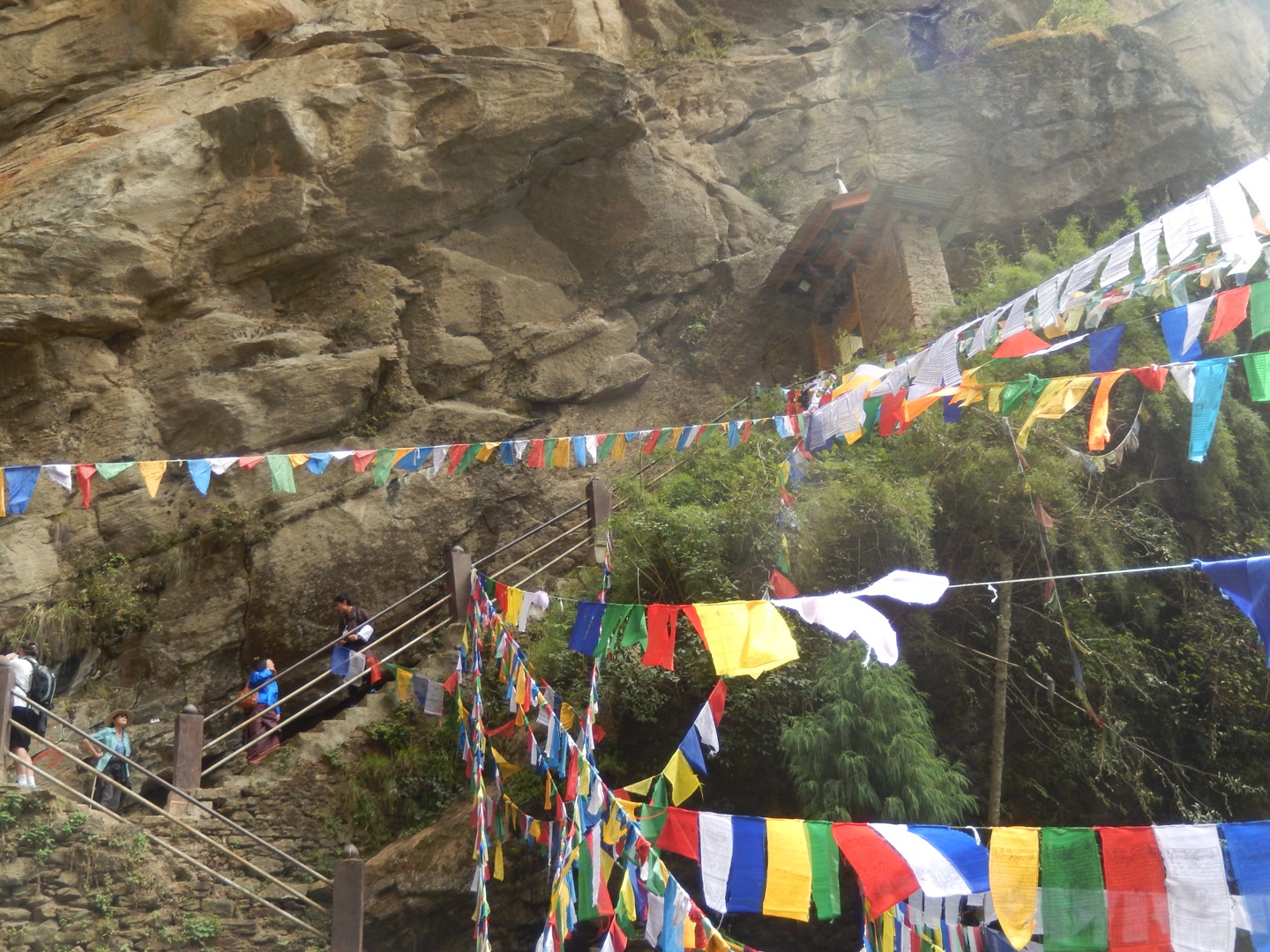 Dogs are everywhere, which is adorable until dawn when they howl and bark like mad. But the feral dogs are beloved because it is believed that they are closest to human in the circle of rebirth.
 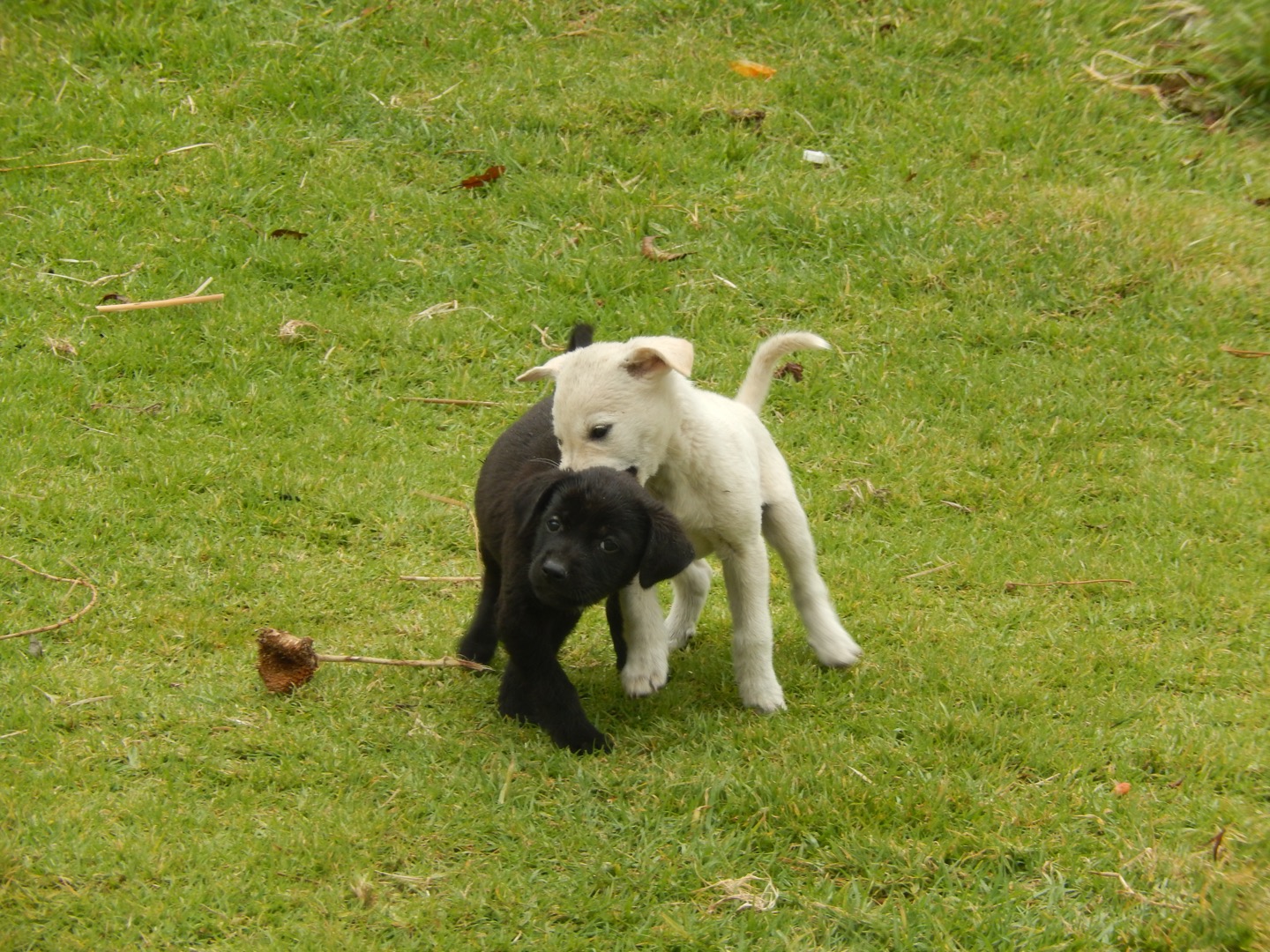 Feeding the street dogs is a way to gain points toward enlightenment. Additionally, in Bhutan, all babies born are taken to the monastery to receive a blessing and their name, which is pulled out of a jar. There are no surnames.
Back at the hotel we skip the evening lecture and instead head to the spa for a nice long massage and rejuvenated cups of ginger tea. Brilliant! The next morning we awaken with no post-hike soreness. We learn later the lecture was about the tigers of Bhutan, apparently there are 200 or so of them in the woods. Yikes.
The following day we tour Buddha point with its humongous statue.  Because the
  interior temple is still under construction, and not yet consecrated, we are allowed to take photos inside (but still must remove shoes, which we have become accustomed to doing everywhere we go at this point)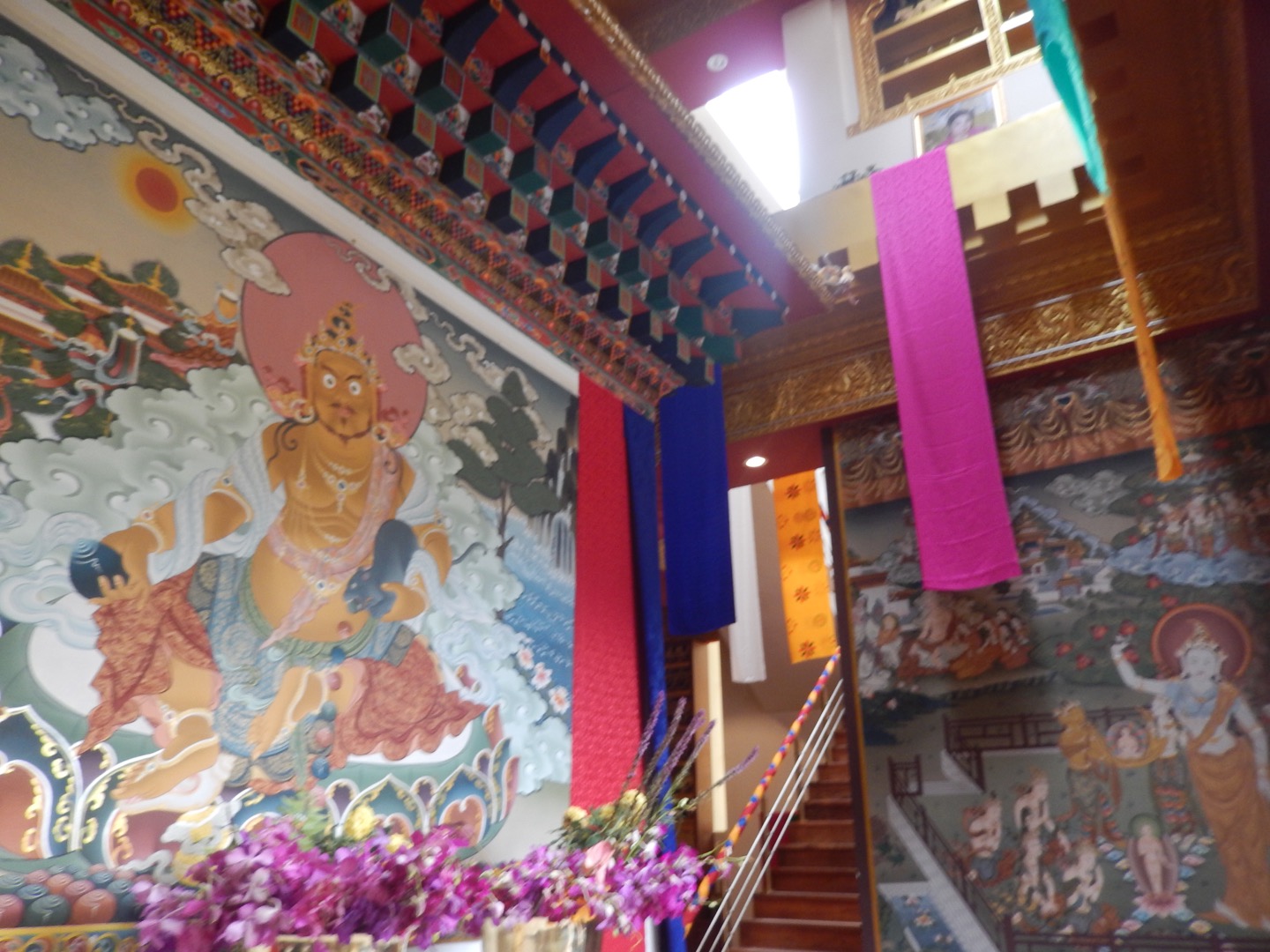
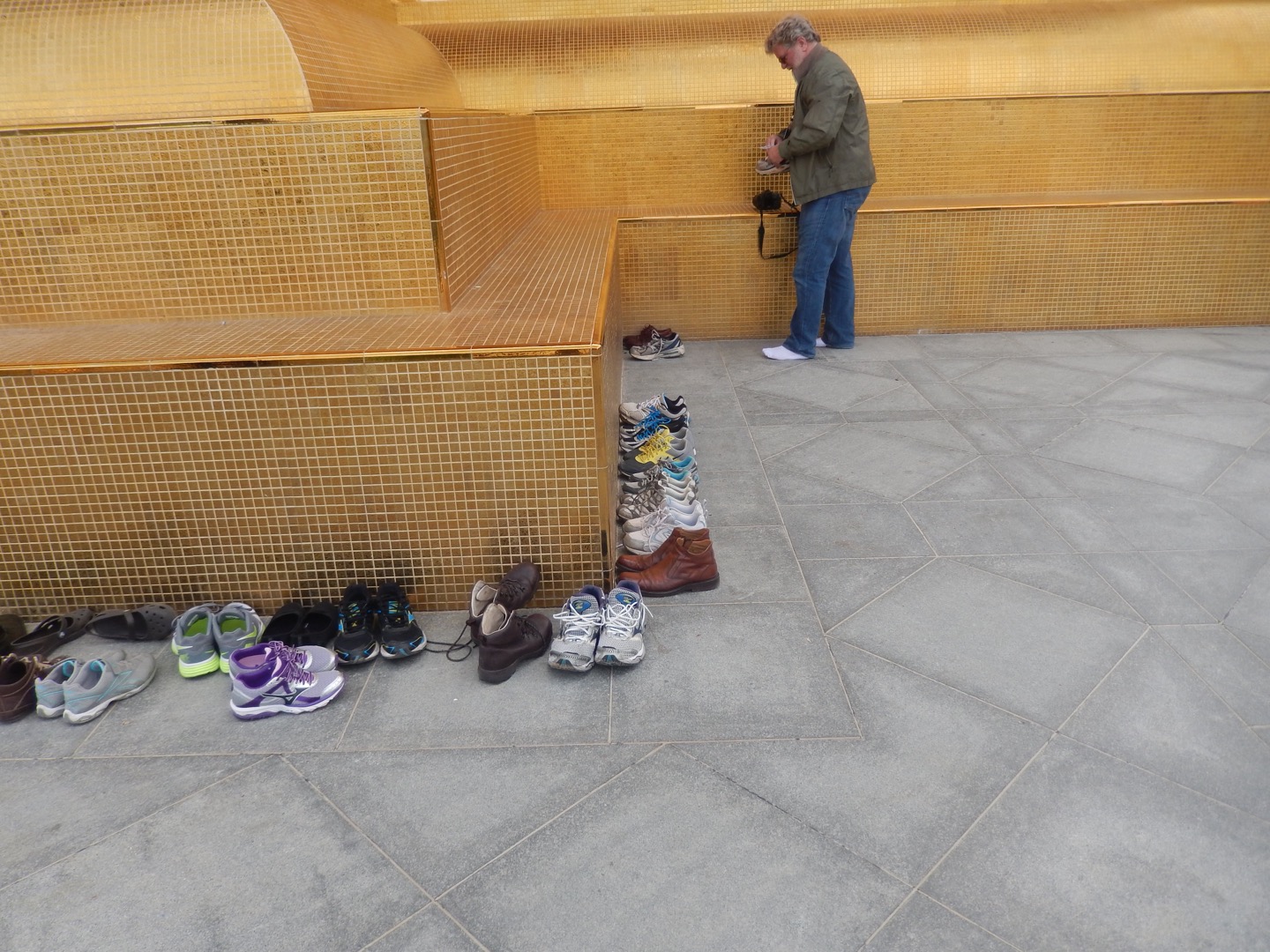
After that we visit memorial Chorten, which is the massive form of the tiny stupa memorials we’ve seen scattered about, erected by the ‘Royal grandmother’ after the death of her son, the third King.  This has become a popular local meeting place for the senior citizens of Bhutan, who gather and pray and gossip.
 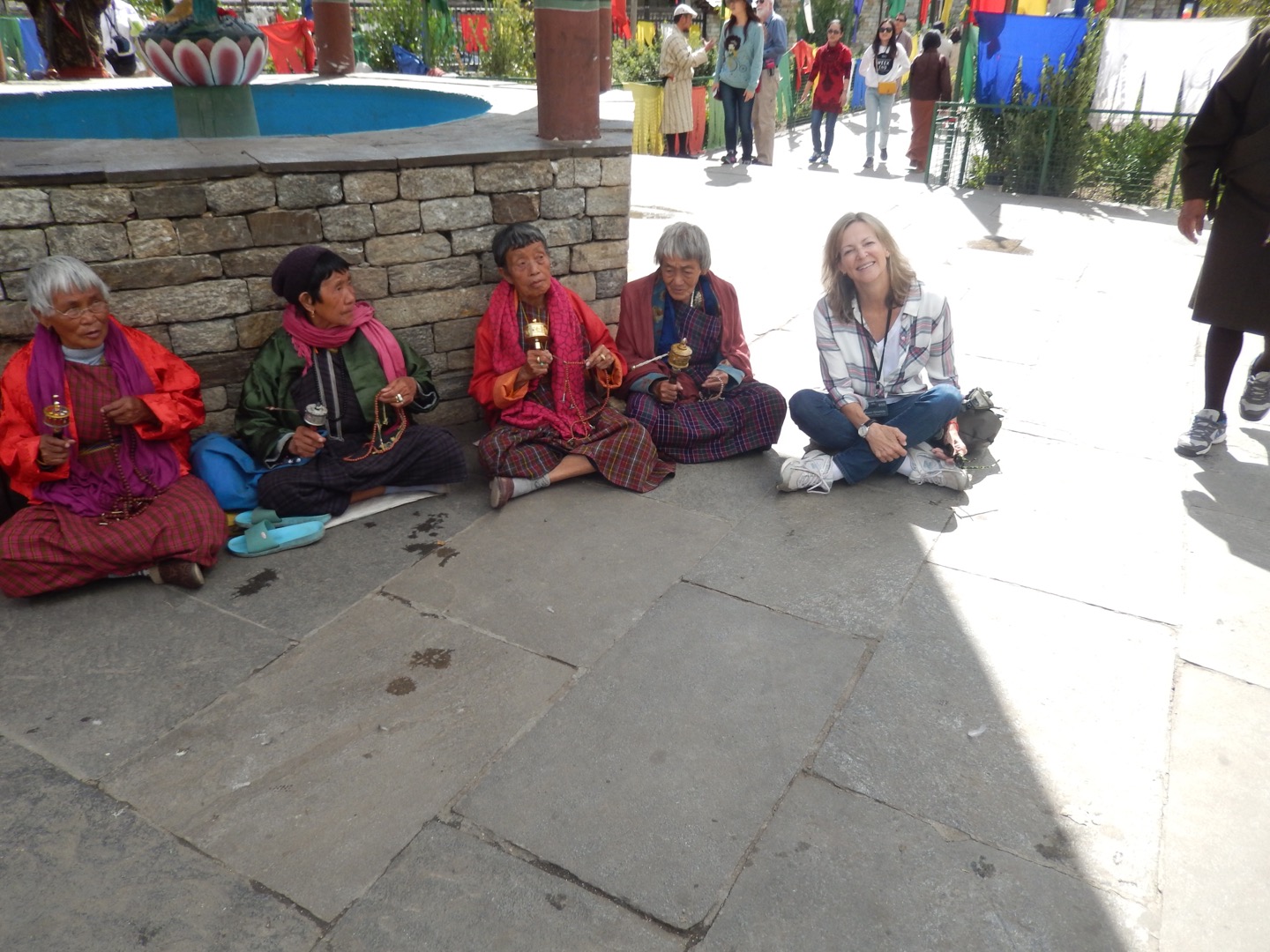 There are prayer wheels and butter lamps and the giant stupa around which people circle with their prayer beads. Each rotation is one prayer or chant and to complete the ritual you make 108 rotations (we make one)
 the beads insure you don’t lose count.
Then we head to Dechen Phrodrang Monastery, a monastic school full of young monks in training. It is as much an honor in Bhutan to have a son at the monastery as it used to be for an Irish family to have a son in the priesthood. While we are visiting the boys are learning English, which is taught in all Bhutan schools. Not all of these young men will be cut out for the life of a monk,
  and as it is not compulsory, many of them will eventually return home.
That evening we are greatly honored to be invited to the home of the queen mother, her majesty Ashi Sangay Choden Wangchuck. We know a bit about her, as like people everywhere, the Bhutan like to gossip about the royal family. Bhutan models their democracy on the UK, so they have elected officials alongside the Royal family, but the government is new and most people still speak as if they live under a monarchy.  This queen is a 4th wife of the retired (not current) king who married 4 sisters simultaneously. Polygamy was practiced widely in Bhutan until recently, although this may partly be due to farms passing through the daughters – so rather than split the farm among more than one daughter, if a man married all the farmer’s daughters, he’d get the whole farm.
The queen’s home is lovely, and she is gracious. (We learn later she has a daughter attending school at Georgetown with our daughter) The Bhutanese in attendance are all big mucky mucks, and we meet an executive from Tashi, who sort of confirms some of our feelings that the gross national happiness, and the intense focus on Buddhism which opposes attachment to material things, means with all of this rapid growth, someone in Bhutan is raking it in. Tashi owns the airlines. They also own the cellphone service (everyone in this country has a cellphone, even the monks, even the ancient aunties who don’t read or write)  they also own the Coca Cola bottling plant. They also own the bank and the tourist industry.
This is where my husband the businessman comes in handy. Talking shop with the Tashi guy, he learns that here in “Shangri-la'” if you want to own a home you must put up 40 percent of the down payment, as the bank will only finance 60 percent, and they won’t do that until you have already invested your money and started construction. Loans are made at 12% for 20 years. There is no such thing as refinancing. Most people make ends meet by renting out all the other rooms in their home to other families. Business loans are made at 15% , and there does not appear to be any shopping around for a better deal.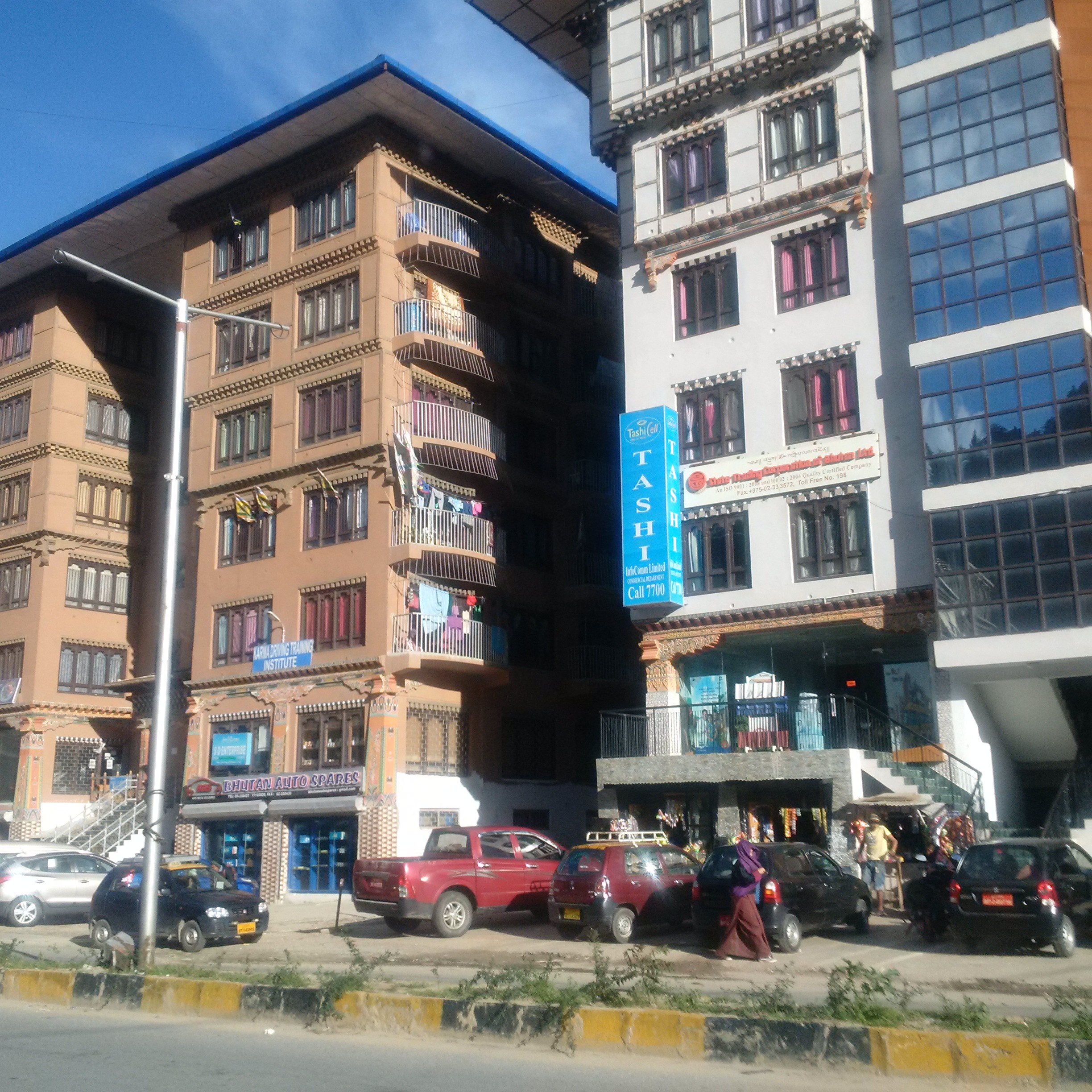
It remains to be seen how the influx of western ways via Internet and television (which they only acquired in the 1990’s) changes this unique culture. They are already having the same problems as everyone else with their young people and unemployment. Drug and alcohol abuse are not strangers here. The queen mother’s charity is a basically a battered women’s shelter. India and China are ‘investing’ like mad.
For now, Bhutan remains beautiful and mysterious and entirely unique. But if you plan to visit, I suggest you do it soon.
 eileengoesroundtheworlddotcom